Oden is a traditional Japanese stew that's often served in the fall and winter by street vendors at little sidewalk stalls. We're somewhat chagrined to admit it, but our interest in oden was spawned, at least in part, by the fox spirit oden stand in xxxHolic, a manga (and now anime) by Clamp. The oden looked so good, and the fox spirits were so cute, that we just had to try some.
Oden is typically filled with an array of tasty bits, often including various types of tofu, fish cakes, and root vegetables. The flavoring is relatively subtle; much like sushi, this isn't a dish that's going to blow you away with spices. The main flavorings are dashi (fish stock), soy sauce, sake, mirin, a little sugar, and the savory flavors the other ingredients release after being simmered for a few hours. That's it. The joy of this dish comes from comparing the subtle flavor and texture differences between the various ingredients, all the while being warmed to the core with steaming hot, savory broth. This is a great soup for a cold winter evening, and thus it's this week's end-of-the-week recipe blogging post.
6 hard-boiled eggs
3 carrots, peeled
3 red (or other waxy) potatoes
~6 inches daikon root, peeled
1 burdock root (gobo, scrubbed but not peeled)
1 block extra firm tofu (~19oz)
1 block fried tofu (abura-age or atsu-age, ~9oz)
1 package fried tofu and vegetable balls (ganmodoki, ~4oz)
1 block yam cake (konnyaku, ~10oz)
1 fish cake (kamaboko, ~6oz)
1 broiled/grilled fish cake (yakichikuwa, ~6.5oz)
1 tubular gluten cake (chikuwabu, ~5oz)
3/4 cup low salt soy sauce
1/2 cup sake
1/4 cup mirin
3 tablespoons sugar
Enough dashi to cover (~12 cups, but may vary widely)
Japanese mustard (karashi; we use prepared neri wakarashi that comes in a small tube)
0. We've read that boiling the yam cake can remove some bitterness; to do this, simmer the yam cake in a pot of water for ~5 minutes.
1. Cut all the solid ingredients into large pieces (~1 1/2-inch cubes or slices for most items; cut the gluten cake into ~1/2" slices, and the fish cakes into ~1/4" thick slices, as they may expand during cooking). The pieces should be a good size to pick up with chopsticks.
2. Put all ingredients except the mustard into a large pot and bring to a bare simmer.
3. Simmer very gently, covered, for at least 1 hour, stirring infrequently; the longer the oden simmers the better (aim for at least 2 hours). You don't want the oden to boil rapidly, as this may cause the ingredients to fall apart.
4. Serve in bowls; attempt to place a sampling of each ingredient into each bowl. Serve with mustard on the side in little dipping bowls; we mix our mustard with a little bit of the oden broth to make a dipping sauce. Japanese mustard is very hot (much like wasabi), so use with caution.
Notes:
Oden is extremely customizable; it can be made with just a couple of ingredients or a whole host of them. We cobbled together the list above by perusing various recipes online, but there's nothing special about what we've included (and we most certainly make no claims as to the authenticity of this recipe). Use whatever you like, and experiment with proportions - the amounts listed above are just what we can easily pick up at our local Japanese market.
To make dashi from scratch, see our recipe here.
To hard-boil eggs, we cover raw eggs with warm tapwater (by at least 1") in a large pot, and then cover the pot and put it over high heat. Once the water boils, we reduce the heat and simmer the eggs for 15 minutes (for large or extra large eggs). Then we drain the hot water from the pot, fill the pot once or twice with cold tap water to stop the eggs from cooking, and then leave the eggs in a bowl of cold tap water until needed. You should be able to hard boil the eggs while you chop the rest of the ingredients.
We don't particularly like the yam cake (we left it out of our most recent batch), but we've included it in the recipe becuase it's apparently a traditional addition to Oden.
Showing posts with label Japanese. Show all posts
Showing posts with label Japanese. Show all posts
Monday, February 26, 2007


Sunday, February 04, 2007
Clear Japanese soup with soba
It's been cold here recently (we got frost here a few weeks ago), and thus my SO and I have been in the mood for soups. One of our current favorites is this quick and easy clear Japanese soup with soba. The broth is a great combination of savory, salty, and sweet, yet it's made from only three ingredients: dashi (the classic Japanese soup stock that's used in many dishes, including miso soup), soy sauce, and mirin (sweet sake). Since we just cooked up a batch of this today (to have as a drink, acutally; see notes), it's this week's end-of-the-week recipe blogging post.
6 cups water
~4" piece konbu (~3-6 square inches)
1 package (10g / 0.35 oz) instant dashi powder (or 6 cups dashi in place of the water, konbu, and dashi powder)
1/4 cup low-salt soy sauce
1/4 cup mirin
2 bundles dry soba (100g / 3.5 oz each)
Nori, cut into thin strips (~1/8" x 2", but it doesn't matter) for garnishing
To make this soup we cook the noodles separately from the broth, put the noodles into a bowl, and then ladle as much broth as we want on top of the cooked noodles.
To make the broth:
1. Bring the 6 cups of water to a boil in a pot large enough to hold it.
2. Reduce the heat to a simmer, add the konbu, and simmer for 5 minutes.
3. Remove the konbu and stir in the dashi powder, soy sauce, and mirin.
4. Keep warm until the soba is ready.
To cook the soba:
1. Follow the package directions. We add the dry soba to a pot of boiling water (not the soup stock), cook for 5 minutes, and then drain the soba.
To assemble the soup:
1. Place the desired amount of soba noodles in each bowl.
2. Ladle a sufficient amount of broth over the noodles.
3. Serve with thinly cut pieces of nori on the side, and extra broth on the table (or in the kitchen), for those who want more.
Notes:
Nori is the toasted sheets of seaweed that are often used to wrap sushi; it adds a nice, crunchy texture to the soup. However, the nori gets soggy quickly, and thus it's best to sprinkle on only a couple pieces at a time as you eat.
We typically use instant dashi powder (instead of making dashi from scratch) primarily because it's quicker and cheaper (shaved bonito is expensive!). If you're using dashi stock instead of the instant powder, just bring the dashi to a simmer and then add the soy sauce and mirin.
Soba are Japanese buckwheat noodles; they're typically brownish in color. We try to get brands that have a high buckwheat content, as many manufacturers dilute the buckwheat with regular wheat flour.
This recipe scales extremely well; make as little or as much as you want. Leftover broth stores extremely well, but soba should ideally be cooked fresh (it gets soggy with storage), so only cook up as much soba as you plan on eating in one sitting.
This soup makes an excellent savory drink as well. My SO and I sometimes make this recipe (leaving out the soba and nori) to drink on on cold days or whenever we're tired of our usual assortment of drinks.
As with all our recipes, we make no representation as to the authenticity of this recipe; in fact, from what we know, soba is most often eaten drained and dipped into small bowls of sauce.
6 cups water
~4" piece konbu (~3-6 square inches)
1 package (10g / 0.35 oz) instant dashi powder (or 6 cups dashi in place of the water, konbu, and dashi powder)
1/4 cup low-salt soy sauce
1/4 cup mirin
2 bundles dry soba (100g / 3.5 oz each)
Nori, cut into thin strips (~1/8" x 2", but it doesn't matter) for garnishing
To make this soup we cook the noodles separately from the broth, put the noodles into a bowl, and then ladle as much broth as we want on top of the cooked noodles.
To make the broth:
1. Bring the 6 cups of water to a boil in a pot large enough to hold it.
2. Reduce the heat to a simmer, add the konbu, and simmer for 5 minutes.
3. Remove the konbu and stir in the dashi powder, soy sauce, and mirin.
4. Keep warm until the soba is ready.
To cook the soba:
1. Follow the package directions. We add the dry soba to a pot of boiling water (not the soup stock), cook for 5 minutes, and then drain the soba.
To assemble the soup:
1. Place the desired amount of soba noodles in each bowl.
2. Ladle a sufficient amount of broth over the noodles.
3. Serve with thinly cut pieces of nori on the side, and extra broth on the table (or in the kitchen), for those who want more.
Notes:
Nori is the toasted sheets of seaweed that are often used to wrap sushi; it adds a nice, crunchy texture to the soup. However, the nori gets soggy quickly, and thus it's best to sprinkle on only a couple pieces at a time as you eat.
We typically use instant dashi powder (instead of making dashi from scratch) primarily because it's quicker and cheaper (shaved bonito is expensive!). If you're using dashi stock instead of the instant powder, just bring the dashi to a simmer and then add the soy sauce and mirin.
Soba are Japanese buckwheat noodles; they're typically brownish in color. We try to get brands that have a high buckwheat content, as many manufacturers dilute the buckwheat with regular wheat flour.
This recipe scales extremely well; make as little or as much as you want. Leftover broth stores extremely well, but soba should ideally be cooked fresh (it gets soggy with storage), so only cook up as much soba as you plan on eating in one sitting.
This soup makes an excellent savory drink as well. My SO and I sometimes make this recipe (leaving out the soba and nori) to drink on on cold days or whenever we're tired of our usual assortment of drinks.
As with all our recipes, we make no representation as to the authenticity of this recipe; in fact, from what we know, soba is most often eaten drained and dipped into small bowls of sauce.
Saturday, July 22, 2006
Japanese curry
Many Asian cuisines include curries, and they're all different. In fact, the term curry is used for so many different dishes that it's hard to define; probably the best general definition is that it's a thick, spicy stew typically served with rice, noodles, or bread. Thai curries tend to be hot-spicy and include coconut milk, fish sauce, garlic, and ginger (see these two recipes). Indian curries are hard to generalize, but they can include yogurt and/or nuts, and are often heavily spiced with turmeric and/or the "C" spices (cardamom, coriander, cloves, cumin, and/or cinnamon; see these two recipes).
Japanese curries tend to be relatively mild, are roux-based (i.e., they're thickened with a mixture of flour and fat), and have a smoother flavor than most other curries we've tasted. We're a bit chagrined to admit it, but since we don't have a recipe for making the spice mix used in Japanese curries, we don't make our Japanese curry paste from scratch. Instead, we use a manufactured curry mix (much like the Thai curry pastes we buy) and add our own ingredients. It tastes marvelous, but we'd really like to learn how to make Japanese curry paste some day. Since we made this curry a few weeks ago, and have been wanting to post a Japanese curry recipe for months, this is this week's first end-of-the-week recipe blogging post.
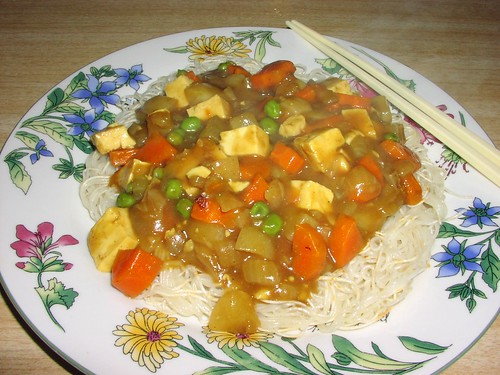
Japanese curry over pan-fried somen noodles.
1 4.2 oz packet of Japanese curry mix (see below for more information)
2 tablespoons vegetable oil
2 medium onions, peeled and coarsely chopped
2 carrots, peeled and cut into bite-sized pieces
2 medium turnips, peeled and cut into bite-sized pieces
1/2 cup peas
1 tub (~16 oz) firm tofu, drained and cut into bite-sized pieces
3 cups water
0. Chop all the vegetables and get them ready to cook. Plan to have either rice or noodles ready by the time the curry is done.
1. Heat the oil in a large nonstick pot over medium-high heat.
2. Add the onions and cook, stirring, until they soften and begin to turn brown at the tips (about 5 minutes).
3. Add the carrots and turnips, and continue cooking for another 3-5 minutes.
4. Add the water and bring to a boil. Reduce the heat and simmer, covered, for 10 minutes, stirring occasionally.
5. Add the peas, return to a simmer, and cook, covered, for another 5 minutes. Then test to make sure everything is cooked to your liking (e.g., make sure the carrots are soft by tasting one or poking it with a fork); otherwise continue simmering.
6. Break the curry paste into smaller pieces and add to the pot, stirring constantly until they're dissolved.
7. Add the tofu and simmer, uncovered, for 5 minutes. Stir constantly but gently.
8. Serve over rice or noodles (we love this curry over pan-fried somen noodles; our recipe for those is here).
Notes:
This recipe is extremely flexible, so use whatever vegetables or meat you desire. This version of the curry is relatively ingredient-heavy; if you wanted more sauce and less stuff (e.g., if you were using the curry as a sauce for fried meat), just add less stuff. Here are a few ideas for variations:
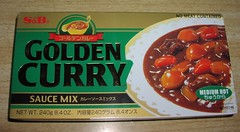
Our curry mix
We make no claims as to the authenticity of this curry or its ingredients; this is just what we like to make.
[Updated Sept. 2007 to add sweet potatoes and jalapeños to the list of possible vegetables, thanks to a delicious turnip, sweet potato, carrot, green bean, jalapeño, garlic, and tofu curry we just made.]
Japanese curries tend to be relatively mild, are roux-based (i.e., they're thickened with a mixture of flour and fat), and have a smoother flavor than most other curries we've tasted. We're a bit chagrined to admit it, but since we don't have a recipe for making the spice mix used in Japanese curries, we don't make our Japanese curry paste from scratch. Instead, we use a manufactured curry mix (much like the Thai curry pastes we buy) and add our own ingredients. It tastes marvelous, but we'd really like to learn how to make Japanese curry paste some day. Since we made this curry a few weeks ago, and have been wanting to post a Japanese curry recipe for months, this is this week's first end-of-the-week recipe blogging post.
Japanese curry over pan-fried somen noodles.
1 4.2 oz packet of Japanese curry mix (see below for more information)
2 tablespoons vegetable oil
2 medium onions, peeled and coarsely chopped
2 carrots, peeled and cut into bite-sized pieces
2 medium turnips, peeled and cut into bite-sized pieces
1/2 cup peas
1 tub (~16 oz) firm tofu, drained and cut into bite-sized pieces
3 cups water
0. Chop all the vegetables and get them ready to cook. Plan to have either rice or noodles ready by the time the curry is done.
1. Heat the oil in a large nonstick pot over medium-high heat.
2. Add the onions and cook, stirring, until they soften and begin to turn brown at the tips (about 5 minutes).
3. Add the carrots and turnips, and continue cooking for another 3-5 minutes.
4. Add the water and bring to a boil. Reduce the heat and simmer, covered, for 10 minutes, stirring occasionally.
5. Add the peas, return to a simmer, and cook, covered, for another 5 minutes. Then test to make sure everything is cooked to your liking (e.g., make sure the carrots are soft by tasting one or poking it with a fork); otherwise continue simmering.
6. Break the curry paste into smaller pieces and add to the pot, stirring constantly until they're dissolved.
7. Add the tofu and simmer, uncovered, for 5 minutes. Stir constantly but gently.
8. Serve over rice or noodles (we love this curry over pan-fried somen noodles; our recipe for those is here).
Notes:
This recipe is extremely flexible, so use whatever vegetables or meat you desire. This version of the curry is relatively ingredient-heavy; if you wanted more sauce and less stuff (e.g., if you were using the curry as a sauce for fried meat), just add less stuff. Here are a few ideas for variations:
- Meat: Include 1 pound of chopped chicken, pork, or beef. Fry this in oil along with the onions.
- Vegetables: Green beans, bell peppers, corn, sweet potatoes, jalapeño peppers, or waxy potatoes (baking potatoes tend to fall apart). Add frozen green beans and corn 10 minutes into the simmering; add fresh green beans, sweet potatoes, and potatoes about 5 minutes into the simmering; add bell peppers and jalapeños along with the onions.
- Flavorings: Add a few cloves of minced garlic after the onions (e.g., along with the carrots and turnips), or use butter instead of the oil.
Our curry mix
We make no claims as to the authenticity of this curry or its ingredients; this is just what we like to make.
[Updated Sept. 2007 to add sweet potatoes and jalapeños to the list of possible vegetables, thanks to a delicious turnip, sweet potato, carrot, green bean, jalapeño, garlic, and tofu curry we just made.]
Subscribe to:
Posts (Atom)

 Posts
Posts

