Showing posts with label pasta. Show all posts

Sunday, September 16, 2007

Homemade fettuccine with butter and garlic sauce

Fresh pasta is a treat; it has an eggy flavor, and a different texture than dried pasta (though describing exactly how it's different is difficult). My SO made some fresh pasta for a special dinner recently, and today we cooked up another batch for breakfast. Fresh pasta is tasty enough that it barely needs any sauce at all; today we had it with butter, garlic, and grated cheese. Since making this reminded us of how relatively easy fresh pasta is to make (just look at the ingredients list!), it's this week's end-of-the-week recipe blogging post.

Note: A pasta roller, such as the one below, makes rolling out and cutting the pasta much easier.
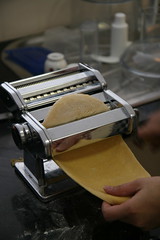

A hand-cranked pasta roller similar to the one we have; Creative Commons image by Allerina & Glen MacLarty

Update January 2011: The fresh pasta made with this recipe can be used with many different sauces; our most frequent pairing over the past few years has been to serve it with our alfredo sauce.  A half recipe of each makes enough for a filling meal for the two of us. 
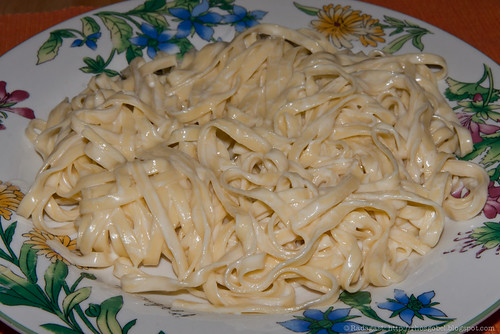
Fettuccine Alfredo
Fettuccine alfredo made with fresh pasta; sauce recipe is here.


Fresh pasta (makes ~1 pound of pasta):
2 1/4 - 3 cups flour (all-purpose flour is fine)
4 large eggs
salt for the cooking water (about 1 tablespoon of salt per gallon of water)

Garlic butter sauce (enough for ~1 pound of pasta):
12 tablespoons butter
2 medium cloves garlic, peeled and finely minced or pressed with a garlic press
Grated pecorino romano cheese, for serving (at least 1/2 cup, though vary to your tastes)

Making the pasta:

0. You'll need plenty of flat, towel-covered table or counter space to hold the pasta after it's been rolled out.
1. Put 2 1/4 cups of flour and the eggs into a food processor and process until the dough begins to come together (about a minute; it's probably best to do this in a number of long pulses).
2. Open the food processor and check how sticky the dough is; it should be slightly tacky to the touch.  If the dough is too sticky, add 1/4 cup more flour and continue processing, checking for stickiness again after the new flour has been incorporated.  If the dough has formed into a single large ball, you may need to manually break up the ball before continuing to process after adding additional flour. 
3. Remove the dough from the processor and press together. Knead by hand on the counter for a few times until the dough is a cohesive mass (maybe 5-10 times). If the dough is sticking to the counter, sprinkle the counter and your hands with flour.
4. Cut the dough into six even pieces, and cover them with plastic wrap (excluding the piece you'll work with first).  Carry out the following steps with each piece of dough. 
5. Roll the dough about 5-10 times through the largest-sized opening on your pasta roller, folding the dough in half between each rolling. By the end of this the dough should be smooth and satiny. If the dough sticks to the rollers or looks rumply after going through the rollers a few times, dust it with flour and continue rolling until it looks smooth and satiny.
6. Once the dough is the proper texture, you'll want to get it to the desired thickness.  To do this, roll the dough repeatedly through the rollers, reducing the width of the opening between the rollers by one notch each time, until you reach your desired thickness. We stop at the penultimate thinness on our Imperia pasta machine for fettuccine, though the thinnest setting can be good for filled pastas. If the dough sticks or tears, simply go back to a larger size, fold the dough in half, and start again.
7. Place the rolled-out dough onto a towel, and let it dry for at least 15 minutes.  This drying step helps prevent the pasta from clumping together when cut; if you're in a hurry you can skip this drying step.
8. Once the dough has dried a bit (so it's a bit less tacky, but nowhere near actually dry), roll it through the desired cutting attachment (or cut the dough by hand). Catch the pasta as it comes out of the cutting attachment, and carefully lay it flat on a towel-covered table. Ideally all the strands of pasta should be separated (so they won't stick), but we don't bother trying to separate all of it (as the pasta tastes just as good if a few strands are stuck together).

Making the sauce:

1. Melt the butter in a small saucepan over medium heat.
2. Add the garlic and cook for 2-3 minutes, or until the pasta is ready.

Cooking and serving the pasta:

1. Bring a pot of salted water to a boil.
2. Add the fresh pasta and cook until it's done; we find that two minutes is sufficient. Unlike dry pasta, we cook fresh pasta by time, as the pasta cooks so quickly that there isn't sufficient time to test it.
3. Drain the pasta thoroughly, and then put into a bowl.
4. Pour the butter and garlic sauce over the pasta and toss to mix.
5. Serve immediately, with plenty of grated cheese.

Notes:

You can mix the pasta by hand instead of using a food processor; in this case put the flour into a bowl, add the eggs, and mix with a fork until the dough comes together. Continue with the pasta-making steps as indicated above.

Many pasta recipes include instructions to knead the dough for 5-10 minutes after it's come together; we've found that just rolling the dough a few extra times in the pasta roller seems to suffice. Joy of Cooking reports that fresh pasta should be allowed to dry for about an hour before cooking; when we first posted this recipe we didn't do this, but now (January 2011) we are letting it dry for at least 15 minutes after rolling.

While we've seen a number of electric pasta rollers for sale, we've used a hand-cranked pasta roller for years, and are perfectly happy with it. However, if you're making pasta by yourself, a powered roller might come in handy as we find that having three hands helps when rolling out the pasta (one of us turns the crank while the other feeds the pasta into the machine and catches it as it comes out).

We've altered the flour amount from our original recipe (which called for 2 1/4 cups), as we've found that the dough consistently comes out far too moist and sticky in our kitchen.  Recently we've been adding 2 1/2 cups of flour to the original mix, and then dusting each portion of kneaded dough a few times during rolling (probably using approximately 2 3/4 cups of flour total).  The size of your eggs, moisture content of your flour, and other factors may cause you to need a different amount of flour than we use.

References:

Medici, L. 1992. Pasta (Williams-Sonoma Kitchen Library). C. Williams, ed. Time Life Books.

Rombauer, I. S., M. R. Becker, and E. Becker. 1997. Joy of Cooking. Scribner, NY.

[Revised January 16, 2011 to change flour amounts, clarify instructions, and add drying time]

Sunday, August 19, 2007

Radagast and SO's creamy chicken pasta

My SO and I love making creamy pasta sauces (e.g., sun-dried tomato and sausage cream sauce pasta, garlic and clam cream sauce pasta, and fettucine alfredo), but a few weeks ago we were in the mood for a chicken-based cream sauce, which we didn't have a recipe for. Thus, we decided to experiment a bit, and came up with a sauce that was filled with garlic, sauteed chicken, sun-dried tomatoes, and creamy goodness. We made the sauce again today, adding some spinach and basil, and came up with this dish. While eating we realized that this reminds us of pasta dishes we've had at places like the Olive Garden or Macaroni Grill; the similarity is unintentional. Since we enjoyed this so much, it's this week's end-of-the-week recipe blogging post.

1/2 to 3/4 pounds chicken (we use boneless, skinless chicken thighs)
Salt and ground black pepper
3 tablespoons olive oil
8 garlic cloves, peeled and minced or pressed with a garlic press
8 sun-dried tomato halves, chopped (we use oil-packed tomatoes)
1/4-1/2 teaspoon crushed red pepper
1/2 cup chicken stock
1/4 cup white wine
4 cups loosely packed fresh spinach
2/3 cup heavy cream
1/4 cup loosely packed chopped fresh basil
1/3 cup grated Pecorino Romano cheese, plus extra for serving
1/2 pound dry pasta (we've used fettuccine and penne)

0a. Cook the pasta in salted water until it is al dente. When cooked, drain the pasta, but do not rinse with water. Work on the sauce (steps 1-9) while the pasta is cooking, though schedule your cooking so the pasta is done just a little before it needs to be added to the sauce (in step 10). We usually start the pasta cooking at around the same time we start sauteing the chicken.
0b. Have the garlic, sun-dried tomatoes, red pepper, chicken stock, wine, and spinach ready to add before you start sauteing the chicken, as they need to be added in quick succession once the chicken is finished. Chopping the basil wouldn't be a bad idea either.
1. Trim the excess fat from the chicken and slice it about 1/2"-thick. Sprinkle with a couple pinches of salt and ground black pepper.
2. Heat the olive oil in a large saucepan over medium-high or high heat. Once the oil is hot, add the chicken. Flip the chicken pieces once the bottoms are well browned, and continue sauteing until they're well browned on their other side. Remove the chicken pieces, leaving the oil in the pan. See the notes section for more information on this step.
3. Immediately add the garlic to the pan and cook, stirring constantly, until the garlic starts to brown (usually about a minute or less).
4. Add the sun-dried tomatoes to the pan and stir for another 30 seconds (or until the garlic is starting to get well browned).
5. Add the crushed red pepper and cook, stirring, for a few seconds.
6. Add the chicken stock and wine, and bring the contents of the pan to a simmer. Reduce the heat, adjusting it during the following steps to maintain a simmer.
7. Add the spinach, stirring to mix. Once the spinach has wilted, add the reserved chicken and continue simmering, stirring occasionally, until the liquid is reduced in volume by approximately half (a few minutes).
8. Add the cream and basil, and simmer until the sauce is a good consistency to coat the pasta, stirring frequently; this usually takes 2-4 minutes.
9. Once the sauce is thickened, mix in the cheese.
10. Add the drained pasta, mix well, and serve with additional grated cheese (if desired).

Notes:

Adding whole spinach leaves results in lots of long pieces of wilted spinach in the dish; we enjoy the texture this adds, but if you think you won't, feel free to chop the spinach before cooking it. You could probably substitute dried basil and frozen spinach for their fresh counterparts without issue (making sure to reduce the volumes added to compensate for their dried and/or frozen states). And, as I alluded to in the introduction, we've also made a version of this without spinach and basil; in that version we substituted 1/2 teaspoon ground sage for the basil (adding the sage along with the crushed red pepper), and left the spinach out entirely. We like the spinach and basil version better, but the sage version is good too.

If you have oil-packed sun-dried tomatoes, and want even more sun-dried tomato flavor, try using 3 tablespoons of the oil from the sun-dried tomatoes in place of the olive oil.

Sauteing the chicken properly is key to adding a lot of browned chicken flavor to this dish. To do this, try to stir the chicken as little as possible once it's been added to the pan, and only flip the chicken once it's golden brown on the first side. Once the sauteing is complete there will probably be lots of little fried bits of chicken left in the pan; by using this pan and the oil still in it for the rest of the dish, you're adding all this flavorful goodness to the rest of the dish.

If, while cooking, you suspect that the pasta won't be ready in time, lower the heat during the simmering (steps 7 and 8) to slow the thickening of the sauce.

This recipe is based on the style of cream sauce in our sun-dried tomato and sausage cream sauce pasta and garlic and clam cream sauce pasta recipes, which we obtained from Weinstein and Scarbrough (2002).

Weinstein, B., and M. Scarbrough. 2002. "How to Make a Light Creamy Pasta Sauce." Fine Cooking 50: 45-49.

Saturday, July 29, 2006

Fettuccine alfredo

Fettuccine alfredo is a luxuriously creamy and delicious pasta dish, yet it has only five ingredients, and is ready in the time it takes the fettuccine to cook. When you're salivating for something rich, creamy, and tasty, this is what you're salivating for.

The perfect fettuccine alfredo is harder to create than one might think. A few weeks ago my SO and I made a batch of fettuccine alfredo, and while we loved it, it wasn't quite perfect (the cheese clumped up when we added it). Thus, being scientists, we set about researching modifications to make our fettuccine alfredo ideal: this was the ultimate in scientific self-sacrifice. Long story short, our second batch1 (made last weekend) was darn near perfection, and thus fettuccine alfredo is this week's first end-of-the-week recipe blogging post.

Before I get to the recipe, I want to add a note on the healthfulness (or lack thereof) of this dish. Fettuccine alfredo is indeed calorie-dense and high in fat, but neither calories nor fat is toxic, and neither directly causes heart attacks. When eaten in large quantities, calorie-dense dishes do tend to lead to weight gain and eventually obesity; obesity is a risk factor for a number of health problems. However, as long as you eat sanely (say, stop eating when you're full, and don't eat another meal until you feel hungry), this dish is perfectly fine to eat occasionally. So please, ignore the "heart attack on a plate" nonsense, and enjoy some luxurious food every now and then.

1 pound dry fettuccine
~1 tablespoon salt (for the pasta water)
8 tablespoons (1 stick) butter (we use salted butter)
1 cup heavy cream
1 cup grated pecorino Romano (or Parmesan) cheese, plus a bit extra for sprinkling on top

1. Cook the pasta in salted water until it's al dente; see below for more details.
2. While the pasta is cooking, melt the butter over medium heat in a saucepan large enough to hold the entire pound of pasta.
3. When the butter is melted, reduce the heat to low and add the cream; heat, but do not boil or simmer.
4. Just before the pasta is finished draining, stir the cheese into the cream and butter until melted.
5. Add the drained (but not rinsed) pasta and toss (or mix) until everything is combined.
6. Serve immediately, with a light grating of pecorino Romano (or Parmesan) cheese on top.


Notes:

You can make a garlic alfredo sauce by adding 4 medium cloves of garlic (peeled and finely minced or pressed with a garlic press) to the butter while it's melting (in step 2), and then cooking that for about 2-4 minutes before adding the cream. To make a pepper alfredo sauce, add 1/4-1/2 teaspoon of ground black pepper with the cheese (in step 4). Or you can make a garlic pepper alfredo sauce by adding both.

This makes enough to serve four as a main course. Unfortunately, leftovers do not reheat well, so it's probably best to make only as much as you want on the day you cook it (we find a half-pound of pasta is good for the two of us). That said, if you do have leftovers, you don't have to throw them away. Store them in the fridge and then reheat in a 350F oven until they're warm (5-10 minutes, stirring at least once). Some of the fat will separate from the sauce on reheating (making the dish look less appetizing and even more unhealthful) but sprinkling it with more grated cheese makes it taste fairly good. At the least it will remind you of the deliciousness that was.

This recipe is slightly modified from Rombauer et al. (1997). Rombauer et al. suggest adding the cheese along with the pasta; we find that the cheese can form large clumps when we do this, and thus we think adding it earlier helps. However, if you were to sprinkle the cheese evenly over the pasta as you mixed the pasta into the sauce, you could probably add it along with the pasta and not form clumps. Rombauer et al. also suggest that you can substitute 1 1/4 pounds fresh fettuccine for the dry fettuccine. We've found that a half-recipe of our homemade fettuccine goes perfectly with a half-recipe of this sauce (making just enough for a full meal for the two of us).


Cooking pasta:

1. Fill a large pot with enough water to cover the pasta (at least 6 quarts), and bring to a boil.
2. Once the water is boiling, add the salt and pasta.
3. Cook for approximately the recommended time on the package, testing the pasta regularly (by tasting it). Do not remove the pasta until it is al dente (just slightly chewy inside); depending on the brand, your pasta may be al dente before, at, or after the recommended cooking time on the package. Don't cook the pasta solely by the time printed on the package.
4. Drain the pasta when it is al dente; do not rinse with water, but add to the sauce as quickly as possible.

Reference:

Rombauer, I. S., M. R. Becker, and E. Becker. 1997. Joy of Cooking. Scribner, NY.

1 - I was really hoping it'd take us five or six tries to get it right.

[Update July 2007: Added information on pepper and garlic additions.  Update January 2011 to add a link to our fresh pasta recipe.]