Showing posts with label breakfast. Show all posts

Sunday, July 29, 2007

Cheese blintzes

Cheese blintzes are thin pancakes that are folded around a sweet cheese filling and then baked or fried so they have a crispy crust. They're are one of my SO's favorite breakfast foods, and thus they appear regularly at birthday breakfasts. Since I made these for my SO's most recent birthday, they're this week's end-of-the-week recipe blogging post.

Blintz batter:
1 1/2 cups flour
1 1/2 cups milk
4 large eggs
3 tablespoons butter, melted
1 tablespoon sugar
Pinch salt
Butter or oil for cooking the blintzes

Cheese filling:
2 1/2 cups drained small-curd cottage cheese (~20-ounces)
4 ounces cream cheese
2 large eggs
1/4 cup sugar
2 teaspoons vanilla
1/2 teaspoon salt

To make this recipe you need to make the blintz batter and cook it, make the filling, and then fill the blintzes and cook them.

To make the blintz batter:
1. Add all the ingredients for the blintz batter to a blender or food processor and blend or process until smooth, scraping down the sides as necessary.
2. Refrigerate the mixture for at least 30 minutes before cooking.

To make the filling:
0. Drain extra liquid from the cottage cheese: put it into a strainer and let it sit for about half an hour. This step could probably be skipped if you're in a hurry.
1. Add the drained cottage cheese, cream cheese, eggs, sugar, vanilla, and salt to a blender or food processor and process until well mixed. There should be no large lumps left after mixing; chill until needed.

To cook the blintzes:
0. Get out your supplies and arrange them around the stove. You'll need a small to medium non-stick pan, the blintz batter, a measuring device for the batter (a 1/8 or 1/4 cup measurer works well), a spatula to remove the blintzes from the pan, a cooling rack or plate to put the blintzes on once they're cooked, and a paper towel or two to clean up the inevitable drips of batter.
1. Heat the pan over medium or medium-high heat, adding a little butter or oil to the pan before cooking the first blintz.
2. When the pan is warm, add about 2 tablespoons (1/8 cup; half of a 1/4 cup measurer) of blintz batter to the pan, then rotate the pan immediately to distribute the batter into a circle.
3. Once the top of the blintz is no longer liquid and shiny, and the underside is golden brown, slide the blintz out of the pan onto a waiting plate. Look the blintz over to see how it turned out, and adjust the cooking time and the stove's heat level based on this inspection (e.g., if the bottom is browning before the top is cooked, turn the heat down). I have an electric stove with only a few heat settings, so I often find myself switching between two heat levels on the stove to maintain the optimum cooking temperature.
4. Continue cooking (steps 2-3) until you've used all the batter (or made as many blintzes as you want to fill).

To fill the blintzes and cook them:
0. Preheat the oven to 350F.
1. Put an individual blintz on a plate, uncooked side up, and place approximately 1-2 tablespoons of filling onto the center of the blintz.
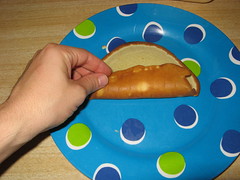
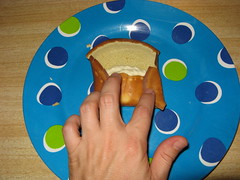
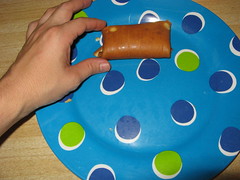
2. Fold one edge (the bottom) of the blintz up onto the filling, fold the two sides in, and then roll the filled portion of the blintz onto the last unfolded edge (the top). This should leave you with a compact packet of blintz neatly surrounding the cheese filling. Repeat for all the blintzes; see figure 1 for more detail.
3. Arrange all the filled blintzes on a baking sheet (we line ours with a non-stick liner, but this is probably not necessary) so that they're not touching, and bake at 350F for 17-20 minutes (or until the filling is heated through and the outside is crispy).
4. Let cool briefly, and serve.
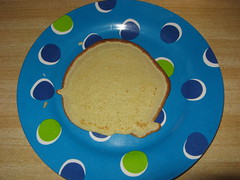
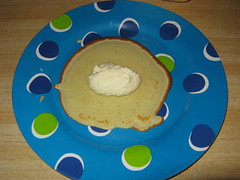
Filling a blintz: part 1 Filling a blintz: part 2 Filling a blintz: part 3 Filling a blintz: part 4 Filling a blintz: part 5
Figure 1: How to fill a blintz.

Notes:

When I cook the blintzes I use two pans simultaneously and fill the cooked blintzes almost immediately after I've slid them out of the pan (as another pair cook in the pans). If you're a beginner at making blintzes, I'd recommend using just one pan and waiting to fill the blintzes until after you've cooked all the batter.

This recipe is based on one in Joy of Cooking (though we've changed the proportions to make the filling sweeter and have more filling for the blintzes). Joy of Cooking specifies that the filled blintzes should be fried in a few tablespoons of oil in a pan on the stove; while this does result in a slightly crispier outside, it's far more tedious than baking, and thus we usually bake ours.

As making crepes and blintzes is so similar, many of these instructions are copied directly from our crepes with a savory chicken and cheese sauce filling recipe. Note, however, that unlike crepes, blintzes are cooked on only one side before filling.

Reference:

Rombauer, I. S., M. R. Becker, and E. Becker. 1997. Joy of Cooking. Scribner, NY.

Sunday, April 01, 2007

Buttermilk pancakes

While my SO and I often don't have "breakfast foods" for breakfast, there are indeed some days when we crave pancakes for the first meal of the day. We've made Joy of Cooking's standard pancake recipe for years, and have been quite happy with the results. However, just a few days ago we made Joy's buttermilk pancake recipe, and immediately fell in love with the thick, fluffy pancakes that resulted. We liked them so much that we made another batch yesterday morning. Since these will now be our standard pancakes, they're this week's second end-of-the-week recipe blogging post.

1 1/2 cups flour
3 tablespoons sugar
1 1/2 teaspoon baking powder
1/2 teaspoon baking soda
1/2 teaspoon salt
1 3/4 cups buttermilk
3 tablespoons unsalted butter
2 large eggs
1/2 teaspoon vanilla

0. Start heating a nonstick pan (or griddle) over medium heat (see notes) a few minutes before you'll be ready to cook the pancakes.
1. Whisk the dry ingredients (flour, sugar, baking powder, baking soda, and salt) together in a large bowl.
2. Mix the wet ingredients (melted butter, buttermilk, eggs, and vanilla) together in another bowl.
3. Pour the wet ingredients onto the dry ingredients, and whisk until just mixed (the mixture should still be somewhat lumpy).
4. Pour about 1/3 cup of the batter into the preheated pan; shake the pan gently to spread the pancake batter out a little, if it's not spreading much. Flip the pancake once a number of bubbles rise to the surface and pop (and/or the bottom of the pancake is getting nicely browned), and continue cooking until the bottom surface is nicely browned.

Notes:

This recipe makes approximately eight five-inch round pancakes (that are about 1/2" thick); plan on two to three pancakes per person.

These pancakes are very thick, and thus take a while to cook. We've found that, at least in our pans on our stove, if we use medium-high (or higher) heat the pancakes brown excessively before cooking inside. Thus, we use medium heat, on which the pancakes take maybe 2-3 minutes a side to cook. The patience you exhibit while cooking over this lower heat will pay off a hundredfold once you taste the fluffy goodness that you'll create.

Cooking with multiple pans simultaneously (or a large griddle) will help speed cooking drastically; we typically use two pans at once.

Depending on your pan, you may or may not need to use butter or oil when you cook the pancakes. I use nonstick pans, but out of tradition I always start the first pancake frying with a little bit of butter in the pan (but then don't add any more butter for the remaining pancakes). I suspect I could get away without adding any extra butter.

We've modified this recipe slightly from Rombauer et al. (1997) by adding a bit more buttermilk.

Rombauer, I. S., M. R. Becker, and E. Becker. 1997. Joy of Cooking. Scribner, NY.

Sunday, March 18, 2007

Cream of wheat with egg

We've made cream of wheat for years, but only recently were inspired to try my SO's grandmother's method of making it with an egg added. The added egg makes the cream of wheat smoother, creamier, and golden in tone. Since we just made some for breakfast yesterday morning, it's this week's end-of-the-week recipe blogging post.

3/4 cup dry cream of wheat cereal (or "creamy wheat cereal" or "farina", if you buy generics)
3 cups milk (we use 1%)
Pinch salt
2 large eggs
Cinnamon sugar, brown sugar, and/or jelly for topping

1) Add the dry cream of wheat cereal, milk, and salt to a heavy-bottomed (preferably nonstick) pot and heat over medium-high heat, stirring often.
2) Once the mixture has started to thicken slightly, whisk in the the eggs.
3) Continue cooking, stirring constantly, until the mixture is the consistency you desire; we like ours rather thick.
4) Serve in bowls, giving the cream of wheat a few minutes to cool before eating (it will thicken slightly on standing); add whatever toppings you desire.

Notes:

We use non-instant dry cream of wheat cereal; we've never tried using instant cereal, so don't know how that would alter the recipe.

This recipe makes enough to feed two hungry people or three mildly hungry people, but also scales extremely well. The basic proportions are 1/2 cup milk to each 1/8 cup (2 tablespoons) of dry cream of wheat, with a minimum of 1 egg and an additional egg for each 3/4 cup of cream of wheat added. In general, we plan on making 3/8 of a cup of cream of wheat per hungry person.

This table should help those who don't like calculating proportions:

Servings Cream of wheat (cups) Milk (cups) Eggs
1 small 1/4 1 1
1 large 3/8 1 1/2 1
2 small 1/2 2 1
3 small or 2 large 3/4 3 2
4 small or 3 moderate 1 4 2
6 small or 4 large 1 1/2 6 3
8 small or 6 moderate 2 8 3
9 small or 6 large 2 1/4 9 4


Note that we haven't made any batches larger than a cup of dry cream of wheat; the larger amounts listed above are extrapolations from our smaller batches.

Saturday, January 14, 2006

Baked French toast

This has been our only French toast recipe since we first made it a few years ago. Thick slices of bread are soaked overnight in a pan with brown sugar and butter on the bottom and half-and-half and eggs on top, then baked the next morning.

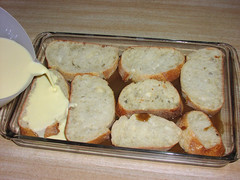
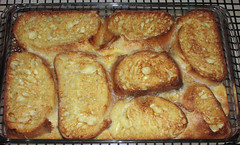
Making baked french toast
Pouring the half-and-half mixture onto the bread

This recipe is easier than any other French toast recipe we've seen; it does take a bit of planning ahead, but once you've sliced the bread and left it to soak overnight all you have to do is groggily pop it in the oven when you wake up, and 40 minutes later you've got hot, crispy, gooey French toast. We made this for our New Years celebration, but since I was too busy last weekend getting my lab manual ready to write a food post, this is this week's end-of-the-week recipe blogging post.

Baked french toast
Hot out of the oven

8 tablespoons (1 stick) butter
1 cup brown sugar
2 tablespoons corn syrup (or honey)
5 eggs
1 1/2 cups half-and-half (or 1 cup milk and 1/2 cup heavy cream)
1 teaspoon vanilla extract
1/4 teaspoon salt
1 pound bread (something like French bread, challah, or ciabatta; don't use bread that has already been sliced for sandwiches)

1. Slice the bread into ~1-inch thick slices (or whatever thickness will allow you to fill a 9x13" baking pan in a single layer).
2. Heat the butter, brown sugar, and corn syrup (or honey) in a small pot over medium heat, stirring regularly, until they are combined.
3. Pour the brown sugar mixture into a 9x13" baking dish.
4. Place the bread into the baking dish, pressing it lightly into the brown sugar mixture.
4. Mix the eggs, half-and-half (or milk and cream), vanilla, and salt in a bowl, and then pour over the bread.
5. Cover and let sit overnight (8 or more hours) in the fridge.
6. Bake in a preheated 350F oven for 40 minutes, or until browned.
7. Serve immediately; we invert the slices so the brown sugar mixture is on top.

We found this recipe online years ago, and have long since lost the link to the source.

Update April 2007: Added honey as an alternate for the corn syrup.