Showing posts with label american. Show all posts

Sunday, March 18, 2007

Cream of wheat with egg

We've made cream of wheat for years, but only recently were inspired to try my SO's grandmother's method of making it with an egg added. The added egg makes the cream of wheat smoother, creamier, and golden in tone. Since we just made some for breakfast yesterday morning, it's this week's end-of-the-week recipe blogging post.

3/4 cup dry cream of wheat cereal (or "creamy wheat cereal" or "farina", if you buy generics)
3 cups milk (we use 1%)
Pinch salt
2 large eggs
Cinnamon sugar, brown sugar, and/or jelly for topping

1) Add the dry cream of wheat cereal, milk, and salt to a heavy-bottomed (preferably nonstick) pot and heat over medium-high heat, stirring often.
2) Once the mixture has started to thicken slightly, whisk in the the eggs.
3) Continue cooking, stirring constantly, until the mixture is the consistency you desire; we like ours rather thick.
4) Serve in bowls, giving the cream of wheat a few minutes to cool before eating (it will thicken slightly on standing); add whatever toppings you desire.

Notes:

We use non-instant dry cream of wheat cereal; we've never tried using instant cereal, so don't know how that would alter the recipe.

This recipe makes enough to feed two hungry people or three mildly hungry people, but also scales extremely well. The basic proportions are 1/2 cup milk to each 1/8 cup (2 tablespoons) of dry cream of wheat, with a minimum of 1 egg and an additional egg for each 3/4 cup of cream of wheat added. In general, we plan on making 3/8 of a cup of cream of wheat per hungry person.

This table should help those who don't like calculating proportions:

Servings Cream of wheat (cups) Milk (cups) Eggs
1 small 1/4 1 1
1 large 3/8 1 1/2 1
2 small 1/2 2 1
3 small or 2 large 3/4 3 2
4 small or 3 moderate 1 4 2
6 small or 4 large 1 1/2 6 3
8 small or 6 moderate 2 8 3
9 small or 6 large 2 1/4 9 4


Note that we haven't made any batches larger than a cup of dry cream of wheat; the larger amounts listed above are extrapolations from our smaller batches.

Sunday, February 18, 2007

Buttermilk mashed potatoes

My SO loves mashed potatoes1, and some version of them has been included in many of our holiday meals to date. However, while we've posted recipes for variants on mashed potatoes, we've never posted our recipe for them. This omission is partly due to the fact that we don't have a recipe for mashed potatoes; we just throw everything together into a bowl, stir, and adjust the flavorings to suit our whims. Thus, to create this recipe we had to do something we hadn't done for years: we measured how much of each ingredient went into our latest batch of mashed potatoes.

This recipe is nothing special; it's just standard American mashed potatoes. Since we just whipped mashed these up tonight, it's this week's end-of-the-week recipe blogging post.

4 pounds potatoes (we typically use russet, but use whatever you prefer)
8 tablespoons (1 stick) salted butter
2 1/2 teaspoons kosher salt (or to taste; plus more for the potato water)
1/2 teaspoon ground black pepper
1/4 cup sour cream
3/4 cup buttermilk

0. Get a large pot of water heating on the stove; we add 1 tablespoon of kosher salt to the water (~6 quarts of water).
1. Wash the potatoes (we scrub them under running water), peel off any green bits of skin, and cut out any bad spots. Leave as much of the skin on as possible, and leave the potatoes whole.
2. Add the potatoes to the water, bring to a boil (if the pot isn't already boiling), and cook until the potatoes are tender (estimated 20-40 minutes, depending on potato size). Test the potatoes by lifting individual potatoes out of the pot with a cooking spoon and poking a paring knife or fork into the center of the potato; if the potato is tender throughout, the potatoes are done (the potato will fall easily off the knife). If your potatoes are uneven sizes, the smaller ones will cook faster; remove them to a strainer when finished and continue cooking the rest until they're done. Remove all potatoes to a strainer when completely cooked.
3. Once drained, put all the hot potatoes into a large bowl and add the butter, salt, and pepper. Mash with a potato masher; continue mashing until potatoes are at the desired level of lumpiness/mashedness. We like to leave ours a little chunky.
4. Stir in the remaining ingredients (sour cream and buttermilk) and mix until well combined. But don't overmix them, as that can make them gluey.
5. Taste the potatoes and adjust the seasonings.

Notes:

Mashed potatoes are incredibly flexible, so adjust this recipe to your liking. If you want them creamier, add more liquid (and/or fat); if you want them butterier, add more butter; if you don't like skins, remove the skins before cooking (this will likely lead to soggy potatoes, however); and if you've got a low tolerance for salt, lower the salt level. That said, don't try to make these with very low levels of salt or fat; both are critical to the flavor of good mashed potatoes.

The buttermilk makes the potatoes tangy, but you can make them with regular milk instead. If you're using regular milk, we'd suggest using about 1/2 cup milk and about 1/2 cup sour cream instead of the amounts listed above.

Some people claim that mashed potatoes don't reheat well; we say "bah" to that. We always make pounds upon pounds of mashed potatoes at a time, and enjoy the leftovers for days afterwards. We just reheat them in the microwave.

If you want a more extravagant meal, put a dollop of butter on each serving of potatoes.

To make wasabi mashed potatoes we add ~1 tablespoon pre-mixed wasabi paste in with the final ingredients. We've previously posted our recipe for cheddar cheese and bacon mashed potatoes. And, if you're looking for something really different, try our mashed turnips and potatoes recipe.

1 Actually, my SO just loves potatoes; my SO's love of mashed potatoes is a subset of this broader love.

Sunday, February 12, 2006

Homemade applesauce

A few years back (before we lived in Southern California), I got extremely ill on a trip to the area. We ended up heading to a friend's house, where I was miserable and couldn't keep any food down for about a day. Once I was feeling a little better, my SO and friend headed out to a local grocery store to buy something inoffensive for me to eat; they chose some generic applesauce. They put a little bit in a bowl for me to try; it was the best-tasting food I have ever eaten. It was like someone had hand-selected the most flavorful apples ever grown, mixed them with the most delicious sugar, and then used some sort of magic to top it off.

Of course by the next day the applesauce tasted just like any regular applesauce, but I've always wanted to have that perfect applesauce again, and today I came about as close as I suspect I ever will. We had about three pounds of apples just sitting around getting old, so we decided to make some applesauce with them (based on a recipe in Joy of Cooking). After a few minutes of peeling, and about half an hour of cooking, we had a pot of absolutely delicious applesauce. Since the applesauce was so good, it's this week's end-of-the-week recipe blogging post.

3 pounds apples (cored and, optionally, peeled)
1 to 1 1/2 tablespoons lemon juice
1/2 to 3/4 cup apple juice or cider
1 cinnamon stick (~3" long)
Scant 1/2 cup sugar (Joy reports you can also use 6 tablespoons honey)

1. Slice the apples into 1/2"-thick slices.
2. Put the apples, lemon juice, apple juice, and cinnamon stick in a pot and bring to a simmer, covered, over medium-high heat.
3. Simmer, covered, for 20 minutes (or until the apples are soft), stirring occasionally.
4. Add the sugar and stir to mix; remove the pot from the heat once the sugar is dissolved.
5. Mash the apples to whatever consistency you desire; we stirred it with a spoon until we had a coarse applesauce, but you could also mash it with a potato masher or put it in a blender or food processor for a finer applesauce.
6. Serve warm or cool (we loved it warm).

Notes:

Joy of Cooking recommends using a mix of apple varieties for the best flavor; we used all Golden Delicious and it was, well, delicious. Joy says to vary the lemon juice amount with the tartness of the apples, and the apple juice amount with the juiciness of the apples; it also suggests that you can add extra flavorings if you desire (1/2 teaspoon nutmeg, 1/2 teaspoon ground mace, and 1/2 to 1 teaspoon ground ginger).

See the notes of this post for more information on buying apple juice.

Rombauer, I. S., M. R. Becker, and E. Becker. 1997. Joy of Cooking. Scribner, NY.

Saturday, January 14, 2006

Baked French toast

This has been our only French toast recipe since we first made it a few years ago. Thick slices of bread are soaked overnight in a pan with brown sugar and butter on the bottom and half-and-half and eggs on top, then baked the next morning.

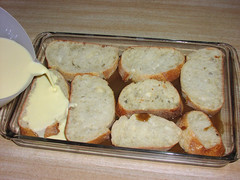
Making baked french toast
Pouring the half-and-half mixture onto the bread

This recipe is easier than any other French toast recipe we've seen; it does take a bit of planning ahead, but once you've sliced the bread and left it to soak overnight all you have to do is groggily pop it in the oven when you wake up, and 40 minutes later you've got hot, crispy, gooey French toast. We made this for our New Years celebration, but since I was too busy last weekend getting my lab manual ready to write a food post, this is this week's end-of-the-week recipe blogging post.

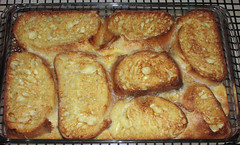
Baked french toast
Hot out of the oven

8 tablespoons (1 stick) butter
1 cup brown sugar
2 tablespoons corn syrup (or honey)
5 eggs
1 1/2 cups half-and-half (or 1 cup milk and 1/2 cup heavy cream)
1 teaspoon vanilla extract
1/4 teaspoon salt
1 pound bread (something like French bread, challah, or ciabatta; don't use bread that has already been sliced for sandwiches)

1. Slice the bread into ~1-inch thick slices (or whatever thickness will allow you to fill a 9x13" baking pan in a single layer).
2. Heat the butter, brown sugar, and corn syrup (or honey) in a small pot over medium heat, stirring regularly, until they are combined.
3. Pour the brown sugar mixture into a 9x13" baking dish.
4. Place the bread into the baking dish, pressing it lightly into the brown sugar mixture.
4. Mix the eggs, half-and-half (or milk and cream), vanilla, and salt in a bowl, and then pour over the bread.
5. Cover and let sit overnight (8 or more hours) in the fridge.
6. Bake in a preheated 350F oven for 40 minutes, or until browned.
7. Serve immediately; we invert the slices so the brown sugar mixture is on top.

We found this recipe online years ago, and have long since lost the link to the source.

Update April 2007: Added honey as an alternate for the corn syrup.

Sunday, October 30, 2005

Very simple hot apple cider

The host of the Halloween party we just attended requested that people bring ethanol-based drinks; we wanted there to be an alternate available, so we made some hot apple cider. Hot apple cider is exceptionally easy to make, and since it's the season for cider, I thought I'd make it this week's end-of-the-week recipe blogging post.

2 gallons unfiltered apple juice or cider
3 3-inch sticks cinnamon

1. Pour the apple juice or cider into a large pot. Add the cinnamon sticks.
2. Heat over medium heat until the cider is a good drinking temperature.
3. Serve hot; we left a ladle in the pot, and the pot on the stove over low heat, throughout the party. The cinnamon flavor becomes stronger the longer you heat the cider, so fish out the cinnamon sticks if it starts to get too strong.

Notes: This recipe (obviously) depends on the quality of the apple juice, so buy the most flavorful available. Apple juice made from freshly pressed apples is the ideal, and a treat - we had it once at Longwood Gardens years ago, and have been craving it ever since. Our current favorite commercial apple juice is Trader Joe's unfiltered apple juice (sold in one-gallon jugs); it's the closest we've found to fresh-pressed apple juice.

This recipe is far simpler than many apple cider recipes, which often include cloves, extra sugar, and other ingredients. We prefer the simplicity of just cinnamon with good apple juice, but flavor to your own tastes; probably the most traditional ingredient we've left out is cloves.

Our cinnamon is very fresh; if you just have a five-year-old jar of cinnamon sticks, you might want to add a few more. If you don't have whole cinnamon sticks, substitute ground cinnamon -- we'd suggest adding a bit at a time and tasting to check the flavor.

Also, remember that we made this for a large party, so feel free to scale down the recipe (though leftover cider tastes good chilled as well).