Thursday, September 30, 2010

Office hours vs. review sessions: the power of a name and a little prep

My campus requires all faculty members to hold four office hours a week.  During these office hours I'm required to be in my office (or some other location), available to any student who wants to come by.

The idea is a great one: there are many reasons why students might want to come and see instructors outside of class, and office hours give all students an opportunity to do just that.  So, in my dream world, I would sit in my cozy office chair sipping tea while student after student came into my office asking thoughtful questions about biology and my advice on transfer possibilities (and bringing me artisan cheese to sample).

But in reality, office hours quickly turn into just another hour to get work done.  Students almost never came by, and when they did it was usually for a few questions that were quickly answered before the student went on their way.  Oh, sure, anytime there was a major assignment due a handful of students would come by to ask about it, but that was at most four or five students every few weeks (I tend to have about 70 to 100 students a semester in my courses).

The lack of student attendance was frustrating, because I knew they could use help (shockingly, they don't all score 100% on my exams, despite my amazing in-class instructing), and I also knew that they wanted help, as there was always a constant chant of "Can you hold a review session?" whenever an exam came up.  I often would hold a specially scheduled review session, while in the back of my mind thinking, "Wasn't that what office hours should have been for?".

And then last year it clicked.  Students desperately want to go to review sessions, but most couldn't care less about office hours.  A quick e-mail to my dean confirmed that there is no requirement to actually call office hours "office hours", and an idea was born: I no longer hold four office hours a week; instead I hold four hours worth of review sessions each week.

I hold the review sessions in the lab I teach my courses in, scatter the hours through the week (to minimize scheduling conflicts), and publish the hours on my syllabus.  I also don't just sit there and wait for student questions; each week I come with prepared slides that list what I can go over that day (e.g., what I think are tough topics), a few new things to talk about (e.g., a preview of material to come, or another example of something we've talked about), and a set of test-like questions from the prior weeks' content aimed at promoting discussion of core topics.  I then ask the students what they want to do, and we go from there.

The weekly review sessions have been a huge hit.  For the primary class I teach (majors' biology), I had four students attend during the first week of the semester (I've never had students come to office hours during the first week to ask about anything other than enrollment issues), in the third week I had seven students attend (even though I had cancelled both review sessions due to being off campus, and only announced that I would be holding one an hour before it was scheduled to start), and last week I had 14 students show up.  This week I haven't even held all the review sessions yet, and I've already had 13 students show up.

In the first four weeks of the semester I had more students come to my review sessions than I typically have come to my office hours in an entire semester.  The students are active and engaged; most stay for the entire time asking me questions and working on my sample questions.  I'm also getting lots of positive feedback ("These are really helping, Prof. Radagast").  And, as an added bonus, since I hold the review sessions in the lab room, students know that they can use the review sessions to give themselves extra time to look at lab specimens, if they need it.

One challenge to this concept is that the review sessions must be specialized for each class.  So, I had to split up my office hours to target each class I teach (luckily I only teach two separate courses), and I've made it clear that I'm happy to schedule office appointments for anyone who can't make the review sessions for their class.  It's not ideal, but the extra attendance and engagement by the students make it worth it.

I think there are three interacting factors that contribute to the success of the review sessions:
  • The name - Students think about "office hours" in a completely different light than they do "review sessions".
  • The location - Instead of walking into my office and interrupting me while I'm doing some probably meaningless, but important-looking task, students instead walk into a room designed for teaching, and see me sitting at the front doing nothing but waiting for them to arrive1.  
  • The preparation - While students end up asking me lots of questions, at the start of each session I usually just get blank stares. Having a few slides prepared with sample test questions, extra content, and a list of what I think is tough helps break the ice and get the session going.  The sample exam questions are especially liked, and much of our time has been spent going over them.

As an added bonus, I'm enjoying the time much more.  Instead of guiltily doing administrivia during office hours, I'm now interacting with my students and helping them learn the content.  Which is, after all, why I'm here.


1 Or, more likely, they're waiting at the lab door and see me rushing from my office to the lab 15 seconds before the review session is scheduled to start.

Sunday, September 26, 2010

Plum frozen yogurt

It's hot here in southern California this weekend1, and thus on Friday I broke out our ice cream maker and made some plum frozen yogurt.  Friends have told me that they haven't had much luck making frozen yogurt at home, as they find it tough to get the yogurt strongly flavored enough with the bits of fruit they add.  I've never had that problem with this recipe: by adding more plum than yogurt, this frozen yogurt ends up filled with plummy goodness, peppered with blended bits of purple skin and small chunks of plum.

This is my favorite homemade frozen yogurt recipe, and it makes an excellent refreshing snack or dessert.

This recipe requires an ice cream maker; for more background on home ice cream makers, see this post.


6 plums (3 to 3 1/2 cups coarsely chopped)
1 3/4 cups whole-milk, plain yogurt (unsweetened)
3/4 - 1 cup sugar


1) Remove the pits from all 6 plums, leaving the skin on.

2) Peel the skin off one of the plums, saving the skin for step 3.  Finely chop the rest of the plum (you should have about 1/2 cup), and set aside.  These plum pieces will be added to the frozen yogurt as it freezes in step 5.

Saturday, September 25, 2010

Who knew Paperboy was based on real life?

While I teach my favorite course on Friday, I'm basically in the classroom prepping, teaching, or cleaning up all day long.  So, come 5:00 I was exceptionally happy to be able to head home (and also exceptionally wiped out).  Unfortunately, though, I didn't know that a video game was awaiting me on my street:
  • As soon as I turned onto my street, I had to slam on the brakes thanks to two dog owners who were chatting while wrangling their large dogs into the open door of their SUV.  Said dogs were on leashes, but extended into the center of the road.
  • After realizing that said dog owners weren't going to get their dogs into the SUV anytime soon, I moved into the opposite lane to drive past the dogs.
  • Immediately after passing the dogs, a young teen on a bike rode out from between two cars in front of me, and slowly crossed the road.  
  • Shortly thereafter a woman closed her car trunk while carrying a large bag of groceries.  Without looking, she crossed the street right in front of me.  (Sadly, there wasn't a baguette or bundle of celery sticking out of the grocery bag)
  • After avoiding the woman (and now going extremely slowly), I noticed a squirrel a few yards ahead of me on the side of the road.  The squirrel darted out into the road as I approached.  Luckily the squirrel thought better of it and darted back.
  • As I neared home, I saw a teenager on a skateboard riding down the sidewalk next to a child on a bike.  Said child was clearly just learning how to ride a bicycle.  The pair slowly wobbled forward, reaching our driveway just as I was ready to turn into it.
Amazingly, nothing happened when I parked.  

Monday, September 20, 2010

Cheese!

In the past few years my SO and I have been bitten by the artisan cheese bug.  We started out sampling the cheeses at Trader Joe's; buying Basque Shepherd's cheese at Trader Joe's was probably the seminal event in our cheese-eating lives. Our friends have learned of our addiction to cheeses, and so for my birthday a few friends went to a cheese store and bought me a selection of cheeses that I'd never tried before. 

Four delicious cheeses
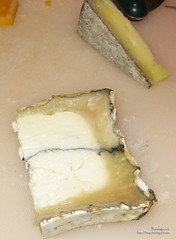
Clockwise from upper left: Beemster extra old (Holland, cow), Lagrein (Italy, cow), Humbolt Fog (California, goat), and Cashel Blue (Ireland, cow)


We broke out the cheeses the day before yesterday, serving them with good bread, almonds, and honey.  Since I know my friends are dying to know how these tasted, here's a quick summary. Note that I'm no cheese expert, so if you're looking for good descriptions I'd suggest you try another source :)

Beemster extra old: This is an aged cow's milk Gouda from Holland.  It's hard to see in the picture, but the cheese is studded with crystals, and thus is fairly showy.  We've had some aged Goudas in the past that were so strong that they were best used for cooking; eating them raw, even with bread and/or honey, proved unsatisfactory.  This Gouda, however, is a perfect eating cheese.  It's filled with good aged flavor, it's caramelly yet savory, but is mild enough that it's great all by itself or with a piece of bread.

Lagrein: This is a cow's milk cheese from Italy, made by the Mila co-op.  The cheese is bathed in red wine and spices, and has a very distinctive purplish rind.  And, oddly enough, it tastes just like a good salami.  I found this cheese to be perfect all by itself; eating it with bread or other sides overwhelmed the moderate flavor, which I wanted to savor all by itself.

 Humbolt Fog (front) and Lagrein (back).

Humbolt Fog: This is a classic California aged goat milk cheese, which I'm embarrassed to say that I hadn't tried before this tasting.  I'm a sucker for ash layers (I've loved the Morbier I've tried), but the ash seems like it's just for show (I didn't notice much of a flavor difference around the ash).  The cheese itself is a delicious melding of two distinct flavors.  The gooey outer region has a savory,  pungent taste with an almost blue flavor from the rind, while the center has a milder, tangy goat cheese flavor.  And since the two flavors are spatially separated, you can decide for yourself which flavor(s) you'll get in any given bite.  We both loved this cheese, and we ate the entire chunk in just one sitting.  The cheese reminded us of Le Chevrot, though the outer gooey portion of Le Chevrot we've eaten has been stronger in flavor.

Cashel Blue: This is a cow's milk blue cheese from Ireland.  Until a few years ago I disliked blue cheese; the classic "blue" flavor just turned me off.  But, I kept trying them, and my first favorite was Roaring Forties, which I had at The Cube in Los Angeles (my favorite cheese restaurant).  Cashel Blue reminds me a lot of Roaring Forties: it's a creamy blue, and was just delicious on bread either by itself or with a dab of honey.  I don't have a lot of experience eating blues, so can't say much more than "I liked it!"

The cheeses made for an absolutely delicious meal; thanks for the present!

Sunday, September 19, 2010

Follow a chemical oceanographer!

A good friend of mine just started a post-doc at Woods Hole Oceanographic Institution, and for his first week at work they decided to throw him on a month-long cruise aboard the RV Atlantis.  He's blogging about his adventures over at The Daily Bucket.


If you've ever wondered what it's like to live and work aboard a research ship sampling water from the depths to analyze for carbon isotope composition, now's your chance!

Saturday, September 18, 2010

Homemade chicken pot pie

My SO and I almost never roast meat, but recently we ended up getting two chickens for free.  So, we roasted them and served them with a delicious gravy.  By the time a week had gone by, we'd already made a number of delicious chicken sandwiches, so were excitedly looking for another way to use the leftovers.  Enter chicken pot pie.

Before we made this, I was never a fan of pot pies.  In fact, I'll admit to having to be dragged kicking and screaming into cooking this.  But then I went back for thirds.  In my defense, most of the pot pies I've had were either frozen vegetables and bland chicken in a sauce that tasted like unseasoned flour topped with cardboard, or were salt-fests with mushy tops. 

Crust: (this is essentially a three-quarters batch of my standard pie crust recipe, made without sugar)
1 7/8 cups white flour (1 3/4 cups plus 2 tablespoons)
3/4 teaspoon salt
12 tablespoons (1 1/2 sticks) unsalted butter
1/4 cup plus 1 tablespoon cold water

Filling:
3 cups cooked chicken, coarsely chopped (we used a mix of dark and light meat)
1/2 pound frozen corn, defrosted
8 tablespoons (1 stick) unsalted butter (reduce salt added if using salted butter)
4 medium carrots, peeled and chopped
2 medium onions, peeled and coarsely chopped
3 medium cloves garlic, peeled and minced or pressed with a garlic press
1/2 cup flour
2 cups chicken stock (we used homemade)
1/2 cup heavy cream
1 cup milk
1 1/4 teaspoons kosher salt (plus more to taste; we added probably ~1/4 teaspoon more)
pinch cayenne pepper
1/4 teaspoon ground black pepper

To cook this recipe, you'll need to sautee the vegetables, make the white sauce, make the pie crust, and then bake the dish.  Try to time everything so that the pie crust has been chilled for at least a few minutes and the vegetables are finished sauteeing by the time the white sauce is finished.

Thursday, May 20, 2010

Relatively easy-to-make crusty peasant loaf

One of my favorite features of writing here on Rhosgobel has always been my "recipe blogging of the week" posts.  Through that little feature my SO and I have posted more than 110 different recipes. While I make no promises about continuing to post one recipe a week, I am happy to return to recipe blogging with the following bread recipe.

Peasant-style loaf with wheat germ.

While I've always enjoyed baking bread, the amount of work entailed in making a good loaf relegated  bread baking to days when I had lots of free time.  My favorite artisan bread baking book is Hamelman's "Bread"; it has incredibly detailed recipes and descriptions of techniques that allowed me to make a few loaves of delicious ciabatta.  However, said ciabatta also took me much work across two days, and thus my SO and I found ourselves frequenting our local bakery whenever we wanted bread.

That all changed when a friend introduced me to a new book, "Artisan Bread in Five Minutes a Day".  I was extremely skeptical at first, as I'm always suspicious of recipes, books, and cooks that promise that home-cooked, old-world taste in two minutes flat ("and $20 off if you order in the next 5 minutes!"1). However, after a few failed attempts, I was able to modify the technique introduced in the book to make a surprisingly good peasant loaf with a minimal amount of work.   Here's the basic outline of the technique:
  1. Mix the ingredients in a large container and allow to rise for three hours at room temperature.
  2. Put the risen dough in the fridge, and refrigerate at least overnight, though it can hold for up to two or three weeks.
  3. Take the dough out of the fridge, pull out as much dough as you want to use that day, roughly shape it, and let it rise for about two hours (folding it after the first 20 minutes).
  4. Bake for ~40 minutes, and let cool until ready to eat.
While I'd hardly call it "bread in five minutes", the ability to have risen bread dough ready to go in the fridge has enabled me to bake bread virtually any day I want it.  Whenever I finish up one batch of dough, I immediately start another; my SO and I almost never buy artisan bread anymore.  So, if you're looking for a crusty loaf of bread that has a chewy, wheaty interior and yet doesn't take a tremendous amount of work to make, you might want to give this a try.

Bread ingredients:
3 cups water, ~100F
1 1/2 tablespoons active dry yeast
1 1/2 tablespoons kosher salt
32.5 ounces (~6 1/4 cups) unbleached white flour
1/3 cup wheat germ

We read old cookbooks

"No, it isn't particularly good, but it may be eaten by the bulging with a clear conscience."

Description of the "Dressing without oil" recipe from Joy of Cooking, 1964.

Rombauer, I. S. and M. R. Becker. 1964. Joy of Cooking. The Bobbs-Merrill Company Inc, Indianapolis, Indiana.

Tuesday, May 18, 2010

What's it like to create a new Facebook account?

I've deleted my personal Facebook account, but since most of my friends still post on Facebook regularly, I wanted a way to keep up with what they're doing.  So I created an empty shell account with a disposable e-mail address that I can use to view what they post (at least until they ditch it as well).

What struck me during this process was just how privacy-invading Facebook's default settings have become.  I found myself thinking "What if my mother-in-law or some other non-net-savvy person was doing this?  Would they understand what was actually being shared?"  So, in this post I'll summarize what Facebook's sign-up process looks like to a new user, focusing on how privacy is presented.


To sign up, users are asked for their name, e-mail, sex, and birthday.  Pretty easy.

Facebook's signup page


Monday, May 17, 2010

Ahhhh, that looks better ...

The housekeeping is largely finished, at least for now.  I've got a shiny new template, a non-swindling comment service, a reorganized sidebar, and a new home for my "recurring features" pages (they're now hosted here on Blogger using the "pages" tool, which will save me a lot of time).  

A few things are missing: I've pared down my sidebar links to what I actually read somewhat regularly (sorry!), I've removed my no-longer-updated delicious page (which I used as a hack to categorize my posts before Blogger came out with its post "labels"), and the old Haloscan comments are gone (sniffle).

Oh, and I can now use "jump breaks", too.  :)

Sunday, May 16, 2010

Housekeeping

A bit of dust has collected here at Rhosgobel over the past few years, and it's going to take me a bit of time to clear it all out.

I'll be updating the template 1 and whatnot, but the biggest change will be in the comments.  Haloscan, the commenting service I've used since starting the blog, has died.  Haloscan transferred the comments to Echo, but in a most user-unfriendly way: while the comments are still visible on the blog, the old comments are neither visible nor editable in Echo's user interface, I have no way to export the comments, and they want me to pay $12 a year for this great arrangement.  So, I'm going to switch to Blogger's commenting system and close the Echo account.  I've saved a selection of the old comments2, but won't be able to go through all the old posts to save every last comment.  It sucks.  Sorry :(

1 I'm still using the template I picked back in 2004!

2 This is why there are currently two "Comment" links below each post; I need to have both Blogger's and Echo's commenting links visible to copy over the old comments.  I apologize for the confusion.  

Saturday, May 15, 2010

A return to Rhosgobel

Regular readers will note that ... well, let's be honest: there are no regular readers of this blog anymore.  I haven't written anything here for more than two years, and haven't posted regularly for longer than that.

What happened?  Many things.  I was diagnosed with carpal tunnel syndrome, and had to drastically cut back my computer use: computer game playing has vanished, online teaching is no more, online reading has been slashed, I'm a slave to typing timers, and writing for fun got largely eliminated.  The pseudonymous nature of the blog also started getting in the way: I found myself wanting to write about items that could lead to someone easily identifying me, and I also wanted to share what I wrote with my circle of local friends, many of whom worked at my campus.

So the blog fizzled.  I was sad to see it go, but I soon replaced it with Facebook, which I enjoyed for the ability to privately share what I thought with close friends without anyone else (students or coworkers) being able to find me.  But in the time I've been using Facebook the privacy settings have gotten steadily worse1 and the company has gotten more and more focused on invading privacy to make money; I've finally gotten tired of it.  I'm leaving Facebook, and replacing it with a mix of other information sharing websites.  I've missed being able to share things I enjoy with people other than my few dozen contacts on Facebook.

So, I'm back.  I'll still write under Radagast, but will be more open about the site with colleagues and I won't try as hard to hide my identity.   However, along with this change will come a separation of public and personal.  Don't expect vacation reports, family news, personal pictures, or the like: those will be shared elsewhere.

Oh, and my wrists are still not great, so I don't promise to post with any regularity.

1 I had the strongest privacy settings possible, yet Facebook still forced me to be visible to "friends of friends", forced my profile pictures to be publicly visible, defaulted all of my (previously private) interests to be public, and started sharing my information with third-party websites without my permission.  Many of these changes were "opt-out", meaning that I had to be aware enough to go in and undo their changes to stay at least somewhat private.  Facebook's focus on "monetizing" the information they've collected on their users' interests and browsing histories irritates me, especially since many users thought their information would be held privately (and few websites are bold enough to ask people to list their religion, sexual orientation, hobbies, educational history, everything they "like", and all of their acquaintances in one place ...).

Sunday, April 06, 2008

Melinda Bossenmeyer: Plagiarist?

Here's a fun evening task: read this post of mine from July 5, 2007, and then read this one "posted by Melinda Bossenmeyer, Ed.D." on July 9, 2007 at Peaceful Playgrounds, Inc.'s "recess blog".

Anything look familiar? If not, I'll point it out for you: Dr. Bossenmeyer's post of July 9 is copied nearly word-for-word from my July 5th post. There have been a number of small changes made throughout the post, but not nearly enough for Dr. Bossenmeyer to call the post her own. Take, for instance, the introduction. Here's mine:
One of the exercise mantras commonly floated about is that adults should get 30 minutes of moderate activity exercise at least five days a week. While this is a good goal, the majority of Americans don't get this amount of exercise1. And, for a lot of beginning exercisers, exercising for 30 minutes a day probably seems like a huge commitment, if not an insurmountable challenge.

My SO and I have long viewed exercise in the "some is better than none" category, and thus try to do even little amounts whenever we can (e.g., walking to the store instead of driving, always taking the stairs at work, doing our own gardening). A recent paper (Church et al., 2007) has shown, via a randomized, controlled trial, that even small amounts of exercise are better than no exercise at all (at least for the subset of people they tested).
And here's the one posted by Dr. Bossenmeyer:
Most all research indicates that adults should get 30 minutes of moderate activity exercise at least five days a week. While this is a research based recommendation, studies indicate that the majority of Americans don't get this amount of exercise1.

A recent paper (Church et al., 2007) has shown, via a randomized, controlled trial, that even small amounts of exercise are better than no exercise at all (at least for the subset of people they tested which were post menopausal women).
And some of the post was simply copied verbatim. Once again, here's my post:
Church et al. divided overweight, post-menopausal women into four groups:
  • Control: Did no exercise a week (other than normal walking)
  • 4kcal/kg: Exercised about 70 minutes a week
  • 8kcal/kg: Exercised about 135 minutes a week
  • 12 kcal/kg: Exercised about 190 minutes a week
Participants were randomly assigned to a condition, and all exercise was performed in a lab2. The participants exercised at their given level for six months, at which point physiological data were compared to data taken at the start of the study.

Fitness improvement correlated linearly with the amount of exercise:
And here's Dr. Bossenmeyer's text:
Church et al. divided overweight, post-menopausal women into four groups:
  • Control: Did no exercise a week (other than normal walking)
  • 4kcal/kg: Exercised about 70 minutes a week
  • 8kcal/kg: Exercised about 135 minutes a week
  • 12 kcal/kg: Exercised about 190 minutes a week
Participants were randomly assigned to a condition, and all exercise was performed in a lab2. The participants exercised at their given level for six months, at which point physiological data were compared to data taken at the start of the study.

Fitness improvement correlated linearly with the amount of exercise:
She even included the three footnotes verbatim, the last of which includes links back to my exercise-tracking blog (and which makes no sense in the context of her blog):
In fact, it was the realization that our fitness was slowly declining (and would continue declining until we would no longer be able to walk when we were 70) that finally motivated my SO and me to start regularly exercising (and tracking our exercise goals and progress here) a few years ago.
There are no links back to my blog (other than the accidental ones to my exercise blog in the footnote), no acknowledgments that I wrote the original post, and she's even added her own copyright notice ("Copyright 2008 Peaceful Playgrounds, Inc." is in the footer of the page). I've never had any communication with Dr. Bossenmeyer that I know of, and certainly never authorized the use of my work on her blog.

I would expect more of a person who's "spent 27 years as an educator and is the author of six published books on playgrounds and numerous articles on recess, playgrounds and play."

[Many thanks to monado, whose recent comment on this post led to me finding this plagiarism. And, just in case something should happen to Dr. Bossenmeyer's "original" post, here are some screenshots of it: 1, 2, 3, 4]

Thursday, February 14, 2008

A most useless doctor visit

For the past few years I've noticed that my wrists have been getting sore after extended periods of computer use. Knowing what this could mean, I attempted to cut down my computer use, and started using programs that encouraged me to take regular breaks1. The soreness became more frequent and came on with shorter periods of use (which is, I might point out, one of many reasons why my posting frequency has dropped precipitously), and then recently I started noticing tingling in my fingers and my mouse hand feeling itchy. So, I decided that enough was enough: it was time to head to the doctor.

The nurse who first saw me had carpal tunnel syndrome herself, and she shared her experiences. Unfortunately, they boiled down to “don't do what I did - I had to have surgery, and still can't use my left hand all that well.” Practical advice on how not to do what she did was rather lacking from her monologue.

So, in came the doctor. He did the usual asking what was wrong, and after my explanation he said, “Well, you've got carpal tunnel syndrome.” He made the diagnosis without ever touching me, or without asking any clarifying questions. Given that after reading online I'd found that there are a few possible conditions that have similar symptoms, I was surprised that he didn't. He then proceeded to explain what causes carpal tunnel syndrome (pressure on a specific nerve; it's always interesting to listen to how doctors dumb down explanations) and that if it got bad enough I might have to have surgery.

Did he bother to say what I needed to do to avoid said surgery? No.

He then asked me whether I used a computer at work, and after I replied with a yes (and that I had a suboptimal work arrangement), he said that that was almost certainly the cause.

Did he bother to ask me if I did other activities (like, say, playing the guitar, or blogging) that might be related? No.

He did, however, go on to talk about how employers are very worried about carpal tunnel syndrome due to the fact that it's the #1 worker's comp injury, and that I should talk to my HR department about getting something ergonomic for my setup (his primary suggestion was, I kid you not, “a gel wrist-pad”). Did he give me any real suggestions on what to do to make my workspace (at home or work) more ergonomic? No. Did he bother talking about any of the range of possible treatments, and discuss with me which would be most appropriate? Other than suggesting that I take off my watch and get a gel wrist-pad, no.

He did ask if my hands tingled when I woke up (which is a symptom of sleeping with bent wrists, an indication that wrist braces may help if worn while sleeping), but then quickly went back to talking about worker's comp.

After a nearly useless conversation, he briskly asked me if I had any other questions, and then shooed me out the door. I learned more in a half hour of web-browsing the night before the appointment than I learned from him, and I'm now left to search the web for more information.

1 Initially I used Ubuntu's built-in typing break program (found in the “Keyboard” menu, at least for Ubuntu 7.04). While this was an excellent start, it was suboptimal (it didn't have an option for micro-breaks, and it would lock the keyboard without much warning, which was frustrating if I was in the middle of a sentence). I also tried a Google Desktop add-in, but that was even less useful (as it just brought up a popup window, which was easy to ignore if I was busy). Most recently I've started using Workrave, a free Linux and Windows program that appears to be excellent: it has both micro- and macro-breaks, gives plenty of warning when breaks are about to appear (I can finish my sentences now!), and is very customizable.

Sunday, January 13, 2008

Buying a classical guitar

Last year I started playing the guitar, and since I thought I'd prefer playing rock music, I bought a steel-string acoustic to learn on. While I've loved playing the guitar, I've realized that I prefer playing classical music.

Classical guitar music is typically played on guitars specially built for the purpose. Classical guitars have smaller bodies than steel-string acoustic (and steel-string electric) guitars; they have shorter1 and wider2 necks; and they use nylon strings instead of steel strings (see Wikipedia for a description of guitar construction). The changes in the neck make fingering somewhat easier (the strings are farther apart, meaning that while the fingers must stretch farther, it's less likely that a finger will accidentally hit multiple strings), and the nylon strings change both the sound (it's mellower) and the pain coefficient (the strings are much easier to hold down without causing pain)3.

So, buying a classical guitar has been on my to-do list since last summer. Regular readers may recall my joyful experience buying my first guitar online. To summarize, I ended up having to return two different guitars, and even the guitar I eventually kept had been slightly damaged. It wasn't a pleasant experience, and it drove home the point that online music stores don't seem to quality-check their merchandise before selling it (or, at least, the two stores I purchased from didn't). Additionally, finding comparable sound samples of guitars online is nearly impossible, making comparison shopping difficult. Given that when I started shopping I was considering spending at least $500 on a classical guitar, I didn't want to take the risk of buying it online.

Shopping advice I found for buying a classical guitar can be summed up as: "Check the guitar for mechanical flaws (buzzing strings, odd noises when playing, cracks, etc.), play a few guitars, and then buy whichever guitar sounds the best to you." Oh, and "bring an experienced player with you if you're a novice." Unfortunately, I didn't have any experienced players who were willing to go shopping with me, and the advice to "buy whichever guitar sounds best" meant very little to me at first, as I had no clue what to listen for. So, that advice wasn't terribly helpful.

To make a long story short, my SO and I made about a dozen trips to different guitar stores over the past six months, and at each store I played as many classical guitars as I could (often about 5-10 different models at each store, until I started narrowing the field). Playing (and more importantly, listening to) all of these different guitars was excellent experience: by the end of the six months my SO and I had both developed better ears, and we felt confident distinguishing different guitars in my price range.

Over this time we figured out a few things that might help someone else shopping for a new guitar:
  1. If you're not great at tuning by ear, bring an electronic tuner and use it to tune every guitar you play. Even at specialty stores, we found that most of the guitars were out of tune4, and even the best guitars sounded awful out of tune. I felt a bit embarrassed about bringing a tuner at first, but it was well worth it.
  2. If possible, find specialty guitar stores in your area. We went to one of the chain retailers, and were disappointed by the quality of their classical guitars (the guitars tended to be horribly out of tune, some had very old/damaged strings on them, and a surprisingly high fraction had mechanical problems, something we didn't find nearly as often at specialty stores). The specialty stores also tended to have a better ambiance (they were quieter and calmer, which is important when the entire point of the excursion is to listen to the guitar you're playing).
  3. Play as wide a range of guitars as you can. Even though I knew I couldn't afford the $4,000 guitars, I still played them, and it was by comparing the sound of $4,000 guitars to $200 guitars that my SO and I started learning what to listen for.
  4. Bring someone with you who can listen to the guitars as you play, even if that person isn't an experienced guitar player. Even though both my SO and I were novice listeners (and my SO doesn't play the guitar), we found it educational to be able to discuss the sound of the guitars (as together we heard more than either one of us individually).
While the shopping was a slow and often frustrating process (models that were in stock one visit were often out of stock the next visit, and the different stores all stocked different models, making comparing our favorites difficult), it was fun to play so many guitars, and this past week I finally settled on one. At the start of the process I'd hoped to spend around $500 for a new guitar, but I ended up spending nearly three times that, as I realized that guitars in that price range just sounded better to me. It's the most expensive chunk of wood I've ever bought, but I love it.

1 The neck of my new classical guitar is 32.5cm long (from the nut to the joint with the body), while my steel-string's neck is 35.5cm long. On a classical guitar the neck joins the body at the twelfth fret, while on my steel-string acoustic the neck joins the body at the fourteenth fret.
2 The width of the neck at the first fret on my new classical guitar is 53mm, while my steel-string acoustic is 44mm wide at the same point.
3 Acoustic steel strings are like little razor blades: they require a lot of force to push down at the frets, and they're so thin that they jab into your fingertips as you do that. When I first started playing on my steel-string acoustic, I couldn't play for more than 15 minutes a day before my fingers started killing me; after a few weeks I built up calluses, but even so it's still mildly painful to play for more than a few hours a day. Nylon strings make fretting much easier - they're thicker and they're plastic, so they don't cut into the fingers nearly as much.
4 While many guitars were just awfully out of tune (and even a simple relative-tuning check would discover the problem), some guitars were relatively in tune (i.e. the strings were in tune relative to each other) but were way off from standard tuning (e.g., the B string was actually playing B-flat). Thus, just checking the guitar by ear to determine if it's relatively in tune wouldn't be sufficient to compare all the guitars on an even footing.

Saturday, January 05, 2008

Gai Tom Ka (Thai coconut and galangal soup)

Both my SO and I have gotten great New Year's presents: little viral bundles of joy. We don't know who gave them to us, but they've certainly been having great fun in our respiratory systems.

So, we've been in the mood for soups, and today my SO cooked up our favorite Thai soup. If you've eaten at Thai restaurants, you'll likely recognize this soup (or something similar). This soup is loaded with strong flavors (galangal, lemongrass, chili peppers, and the traditional Thai fish sauce), and thus should always be served with copious quantities of plain rice (we mix the rice right into the soup as we eat). This soup is the perfect dish for a cold winter day, and since it made for a delicious sick-day breakfast1, it's this week's end-of-the-week recipe blogging post.

8 cups chicken stock
1/2 cup fish sauce
4-inch piece fresh galangal (or ginger), roughly chopped (unpeeled)
2 4-inch pieces of lemongrass stalk, washed and chopped into 1/4-1/2-inch long pieces
10 kaffir lime leaves, torn into several pieces (optional)
4 red jalapeños or other chili peppers, seeded, deveined, and cut into strips
2/3 cup lime juice (or lemon juice)
1 can (~13.5 fl. oz.) coconut milk
1/2 - 1 pound chicken (sliced into ~1/4-inch-thick slices) and/or tofu (cut into 1/4 - 1/2-inch cubes)
chopped cilantro (optional; as a garnish)
cooked white or brown rice (we'd suggest cooking about 2/3 - 1 cup of dry white or brown rice per large bowlful of soup)

0. Prepare plain white or brown rice to serve with the soup. We cook up about 2 cups dry white rice for the two of us when we make this soup for a full meal, and have relatively little rice left over but have about half the soup left over.
1. Add the chicken stock and fish sauce to a pot and bring to a simmer.
2. If you have cheesecloth available, wrap the galangal (or ginger), lemongrass, and lime leaves in a large piece of it and tie into a bundle (to make removing them from the broth easier).
3. Add the galangal (or ginger), lemongrass, and lime leaves to the simmering stock, and cook for 10 minutes.
4. If you haven't wrapped the galangal (or ginger), lemongrass, and lime leaves in cheesecloth, strain them out of the broth now.
5. Add the lime (or lemon) juice and jalapeños, and continue simmering for another 10 minutes.
6. If you used cheesecloth (in step 2), remove the cheesecloth bundle now. Add the coconut milk and chicken and/or tofu, and simmer until the chicken is cooked and/or the tofu is heated through (~3 minutes).
7. Serve along with plain white or brown steamed rice, garnished with chopped cilantro (if desired).

Notes:

Obtaining the ingredients for this dish requires finding a market that stocks Asian ingredients. In our area, fish sauce and coconut milk can be found in the Asian section of most supermarkets, but items like fresh lemongrass, galangal, and lime leaves are found only in specialty Asian markets that stock Thai ingredients (look in the produce section).

Don't despair if you can't find fresh galangal or lime leaves; we've made the soup many times using just fresh ginger in place of the galangal and omitting the lime leaves, and it's been fine. While galangal and ginger don't taste identical, they're fairly similar. Galangal, ginger, and lime leaves store fine for months in the freezer (ginger and galangal don't even have to be wrapped to freeze). However, we would advise against using dried ginger or galangal, as the drying process dramatically changes their flavors. We don't know how using dried lemongrass would affect the soup, as we always use fresh (see below). We've never served the soup with the cilantro garnish, but it is traditional.

If you live in the Southern California area and know that you like Thai food, you might consider growing your own lemongrass, as it does well here. We planted a tiny plant a few years ago, and besides rare waterings it's just about taken care of itself (while growing into a nice-smelling, rather attractive 5-foot wide plant). Note that lemongrass leaves are very sharp along the edges, so wear gloves while harvesting.

We based this recipe on one in Bhumichitr (1988).

Bhumichitr, Vatcharin, 1988. The Taste of Thailand. MacMillan, NY.

1 And, since the soup was so strongly flavored, we could actually taste it with our cold-impaired senses!

Thursday, December 27, 2007

A nearly vegetarian Christmas dinner

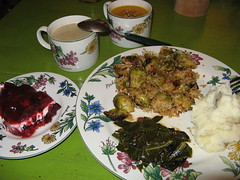
Christmas dinner
Follow the link to see a labeled version of this image.

My SO and I regularly cook big holiday meals. As is traditional, these have typically featured a central meat course surrounded by a number of vegetable-based sides. Upon pondering what we wanted to cook for this year's Christmas dinner we realized, however, that when it came right down to it the central meat course wasn't really all that central. So, this year my SO and I decided to try a Christmas dinner without the central meat course. Here was our menu:
While the relatives we've described this to have been surprised by the lack of meat ("Not even a tofurkey?"), we hardly even noticed it. Our plates and bowls were full of diverse flavors and textures, and we were so stuffed by the time the sweet potatoes finally came out of the oven that neither of us even had any that night.

Saturday, December 22, 2007

Homemade grainy mustard

Every year my SO and I send out homemade holiday presents to our families. Our two most requested presents are our fruitcake and our mustard, and since we've made these recipes for nearly 10 years now, we figure it's time to share. I'll be posting the mustard today, followed followed by the fruitcake recipe in a few weeks (once we've had time to experiment some with the recipe).

Our mustard is made from whole yellow and brown mustard seeds that have been only partially crushed, and thus you get treated to little bursts of mustard flavor as you eat. The flavor is different from store-bought mustards: our mustard is sharper than most, doesn't taste as much of vinegar or turmeric, and has a hint of onions thanks to shallots. We have reports from family members that even though they've tried, they can't find anything like this in stores. Since we just got finished making our annual batch of mustard a few days ago1, it's this week's end-of-the-week recipe blogging post.

Note that this recipe requires a few days to soak the mustard seeds before making, and tastes best if left to mellow for a week or two before eating, so plan accordingly.

1/2 cup dry yellow mustard seeds
1/2 cup dry brown mustard seeds
1 cup rice vinegar
1 shallot, finely chopped
1 tablespoon kosher salt

1. Put the brown and yellow mustard seeds into separate containers and add approximately 3/8 cup (1/4 cup plus 2 tablespoons) of rice vinegar to each container. Cover each container tightly and let sit at room temperature for at least 2 days, stirring occasionally. If the mustard seeds end up looking dry during the soaking period, add a bit more vinegar to moisten.
2. Grind each type of mustard seed until many of the seeds have broken open (the seeds should start clumping together, and you'll start to see little bits of seeds in addition to whole seeds). For an artisanal feel, you can do this by hand with a mortar and pestle; it's a lot of hard work, and is guaranteed to make your grinding arm sore. For the lazy cook's mustard, put the seeds into a food processor and process with long pulses. It's best to grind the two types of seeds separately, as the yellow and brown mustard seeds grind at different rates.
3. Mix the mustard seeds, salt, shallot, and remaining vinegar (~1/4 cup) in a bowl. Add extra vinegar to bring the mustard to a nice paste-like consistency (it may take an extra tablespoon or so).
4. Transfer to jars and store in the fridge.

Notes:

Don't use aluminum cookware with this recipe, as it may react with the vinegar.

There's no need to use exactly 1/2 cup of each type of mustard seed; as long as you have a total of one cup of seeds you should be fine. The yellow seeds are milder than the brown seeds, so variations in proportions will change the sharpness of the final product.

We store the mustard in sealed jars in the fridge, though it may not require refrigeration (and we regularly ship it cross country without issue). The mustard keeps for a long time; we've kept jars in the fridge for more than a year and it still tastes great.

The recipe above makes a bit less than 2 cups of finished mustard. We typically make at least five times that amount (2 1/2 cups of each type of seed, ~2 cups of vinegar to soak each type of seed initially, 5 tablespoons kosher salt, 5 shallots, and 1 to 1 1/2 cups vinegar for mixing at the end), and as long as you're using a food processor for grinding you won't go crazy. In the past we've always hand-ground small batches of mustard; we only recently started using a food processor due to making large batches, and thus we're not sure how well a food processor will work with a small batch of mustard.

This recipe is based on one in Walden (1995), a book which wins the Radagast and SO award for best food photography.

Reference:

Walden, H. 1995. Sensational Preserves: 250 recipes for jams, jellies, chutneys, and sauces. Reader's Digest, NY.

1 And yes, this means that if you're a family member waiting for your holiday mustard shipment, your mustard is indeed in the mail.

Tuesday, December 18, 2007

It is done.

I'm pleased to report that the semester is finally over. I finished my grades last night, and this afternoon I finished off all the fiddly end-of-semester work that I'd been putting off. My e-mail has an away message, my voice mail won't be checked for weeks, and I have nothing I need to do for work until January. Ahhhhhh.

How did I celebrate? By coming home and taking a nap.

Friday, December 14, 2007

Stay on target ...

The end of the semester has proven to be insanely busy. Even though many instructors at my college have already turned in their grades, I still have dozens of papers to grade and haven't even given my last final exam yet. This is even though my SO has been querying me for my name when I arrive home, thanks to me working solid 10 or 12 hour days for at least the last two weeks (including weekends).

Making things even more "fun" is that I've had the "pleasure" of turning in more than a dozen different students for plagiarizing this semester, most of them in the past week and a half. I've even set a new personal record for the greatest fraction of plagiarizers in a course: 50% of the completing class.

More to come once grades are in.