Semantic Compositions has just posted some big news: he's starting his own company! This sounds like a great decision for him; I wish him all the best.
And, if he ever needs a biologist to consult for him, I'll be happy to give him my special friends-only discount rate (based on, of course, the rates his prior employer charges).
Wednesday, June 13, 2007


A little fluff
My SO and I are busy working on the house this week1, so here are a few resources to entertain you:
High-speed pictures of milk dropping into coffee (via BoingBoing)
Video of flight traffic patterns over the US (higher-quality here) (via PZ)2
Demonstration of the power of CSS (via Semantic Compositions)
1 It's amazing how long seemingly simple tasks can take when one is remodeling. For instance, I just spent most of today painting (and priming, and patching) a door frame. On HGTV things like that take about 5 seconds (if they even show it).
2 Moral of the story: If you don't want to have planes flying over you all day, go live in the Pacific northwest.
Sunday, June 10, 2007
Roasted cauliflower
A few years ago my SO came across this recipe for roasting cauliflower. We posted a link to it way back when, and since then it's been one of our most-cooked recipes. However, the original recipe is written rather vaguely, and thus we're re-posting it here with more detailed instructions. This is also one of this week's end-of-the-week recipe blogging posts, as we just made this again last week.
And, to reiterate what we've said before, this is quite possibly the world's best method of cooking cauliflower; if you haven't tried it yet, you're missing out.
1 head cauliflower, rinsed (approximately 2 pounds untrimmed; ~1 3/4 pounds trimmed)
2 tablespoons olive oil
1/2 teaspoon kosher salt
1/4 teaspoon ground black pepper
0. Preheat your oven to 475F.
1. Remove the leaves and any bad spots from the cauliflower.
2. Cut the head of cauliflower into florets. We prefer large-ish florets (maybe 1 1/2 inches in diameter), though the size doesn't matter much. You can also chop the stem and include that as well (we cut the stem into ~1/4" thick slices).
3. Put the florets and stem slices in a roasting pan large enough to hold them in a single layer, and then sprinkle with the olive oil, salt, and pepper. Stir to mix.
4. Roast for 35 minutes, or until there are numerous small browned/blackened bits in the pan, and all the florets are well browned in spots (they'll appear to be almost burned). Stir every 10 minutes while baking, using a wooden spoon/spatula to scrape the stuck pieces off the bottom.
5. Serve immediately.
Notes:
This is best immediately after it comes out of the oven; it tends to get a bit mushy and lose some of its excellent flavor once it has cooled. The little nearly-burned bits in the bottom of the pan are full of flavor; we enjoy scraping them out of the pan and adding them to our plates.
This makes enough to serve as the primary component of a meal for two; it'd probably make enough for a side dish for four, though we rarely serve it as a side dish. This is perfectly delicious plain, but can be served with a cheese sauce if desired.
This recipe scales well, so feel free to vary the amount of cauliflower (as long as the cauliflower fits in a single layer in your roasting pan).
Reference:
Weide, Stephanie Vander. 2004. "Blue Plate Special: Cauliflower and Crabs". Grub Report, December 12, 2004. http://www.grubreport.com/blueplatespecial/caulicrabs.html. Accessed 2005.
Peanut butter chocolate chip cookies
My SO and I love moist, chewy cookies. We were thus ecstatic when we found this recipe, which makes huge cookies (they're about 3 1/2" in diameter and about 3/4" thick) that stay moist and chewy for days after cooking. Since we've gotten rave reviews of these from friends recently, they're this week's first end-of-the-week recipe blogging post.
1/2 cup (1 stick) butter, softened
1/2 cup crunchy peanut butter
1/2 cup sugar
1 cup brown sugar, packed
2 large eggs
2 tablespoons light corn syrup
2 tablespoons milk
2 teaspoons vanilla extract
1 1/2 cups flour
1 teaspoon baking soda
1/2 teaspoon salt
2 cups semi-sweet chocolate chips
0. Soften the butter (by letting it sit out at room temperature for a while), and preheat your oven to 375F.
1. Cream the butter, peanut butter, sugar, and brown sugar together in a large bowl (we use our stand mixer) until it is as smooth as it will get with the peanut chunks in it.
2. Add the eggs one at a time, mixing after each addition.
3. Mix in the corn syrup, milk, and vanilla.
4. Mix the flour, baking soda, baking powder, and salt together in a bowl.
5. Add the flour mixture to the wet ingredients, mixing until well combined.
6. Add the chocolate chips, mixing until just combined.
7. Measure out 1/4 cup chunks of dough and place onto a cookie sheet. We use a silicone cookie sheet liner to make removing the cookies easier after baking; you may want to grease your cookie sheets if you don't have a liner.
8. Bake for 13 minutes at 375F, or until the cookies are turning brown at the edges. They may appear slightly underbaked; this is OK, as they'll continue cooking a bit outside the oven (though test various cooking times to see what best suits your oven and tastes).
9. Let rest on the cookie sheet (out of the oven) for a minute or so, then remove the cookies to a rack to cool completely.
Notes:
If you want smoother cookies, use non-chunky peanut butter. We use the standard variety peanut butter that's been salted and sugared, but this is almost certainly flexible.
Based on a recipe by Kathy Bliesner from Allrecipes.com.
Bliesner, Kathy. "Chewy Peanut Butter Chocolate Chip Cookies" http://allrecipes.com/Recipe/Chewy-Peanut-Butter-Chocolate-Chip-Cookies/Detail.aspx. Accessed April 2003.
Thursday, June 07, 2007
Installing Ubuntu 7.04 - Feisty Fawn
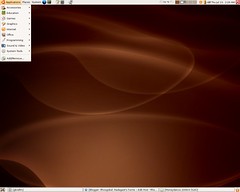
Today I finally got around to installing the latest version of Ubuntu (7.04 - Feisty Fawn). The installation was very easy, especially since my original partition plan included a blank 12 GB partition to hold a new version of Ubuntu. All I had to do was download the 7.04 live CD, boot from it, and then install Ubuntu 7.04 to the blank partition I'd created way back when1.
The look and feel of this version (7.04 - Feisty Fawn) is much the same as the prior version (6.06 - Dapper Drake), so everything I'd learned about 6.06 transferred right over to the newest version. However, there are two major improvements I've already noticed:
- Restricted drivers manger - This little menu item (System -> Administration -> Restricted Drivers Manager) allowed me to install my nVidia video card's driver in less than a minute. In the old version (6.06) I'd had to go and find the package manually, and then fiddle with a few settings. In Feisty Fawn all I had to do was click one button and it was installed.
- Multimedia codec finder - Whenever I click on a media type to play it, Ubuntu now automatically checks to make sure that it has the proper codec installed. If it doesn't have the right codec installed, it searches the repositories, finds the proper package, and asks if I want to download it. I've now been able to play mp3s, quicktime videos, and flash videos all within 30 seconds of clicking on them.
- I installed gaim-guifications, a package that lets Gaim pop up notification windows whenever I have an incoming message (much like Google Talk, Outlook, and other programs do in Windows). After installing the package ("gaim-guifications"), I had to enable it in the "plugins" menu of Gaim.
- I installed my usual assortment of FireFox extensions, including Adblock Plus (which blocks ads), Adblock Filterset.G updater (which automatically updates Adblock's list of ads to block), Flashblock (which automatically blocks all flash applications from starting, preventing many websites from being annoying), Tab Mix Plus (which, among other things, allows you to force all new windows to open in new tabs), and Video Downloader (whose purpose should be fairly intuitive).
- I also configured FireFox so that it would allow smaller tabs, meaning that I won't have to scroll left and right to see all my tabs if I open too many. To do this I went to "about:config" in the browser window and then edited the "browser.tabs.tabMinWidth" value to be 20 (the default was 100; installing the Tab Mix Plus extension meant I had to change the "extensions.tabmix.minWidth" value as well).
- Installed cups-pdf, a package that creates a PDF printer (so I can convert anything I want into a PDF simply by printing it). I followed the instructions here, but essentially all you have to do is install the package "cups-pdf" and then add a new printer (selecting the PDF printer, and then choosing "generic color postscript" as the options). All created PDFs go into the "PDF" directory of your home directory; sym-link this to wherever you want them to go.
- Installed my image resizing script; this required me to install ImageMagick (via the "imagemagick" package), but otherwise was simple.
1 The only problem I've run into so far was that Ubuntu set my maximum resolution to be 1024x768. To fix this I had to manually edit my X configuration file ("gksudo gedit /etc/X11/xorg.conf") and add the option to use a 1280x1024 resolution (by adding that resolution in the "screen" section of the file, next to all the other resolutions listed).
2 In fact, I just reduced the size of my Windows partition so that I'd have more space for files in Ubuntu.
In the news
Looks like I was right; CNN has finally decided that 100% fruit juice won't make your kids fat after all.
Carbon dating of chicken remains in South America has provided evidence that Polynesians sailed to the Americas at least a hundred years before the Spanish did. Chickens are not native to the Americas, yet the chicken remains date to AD 1321 to 1407.
And, don't expect widespread Mad Cow testing to occur anytime soon in the US; the Bush administration is fighting to prevent a company from testing all their cows for the disease:
The Bush administration said Tuesday it will fight to keep meatpackers from testing all their animals for mad cow disease .
The Agriculture Department tests less than 1 percent of slaughtered cows for the disease, which can be fatal to humans who eat tainted beef. But Kansas-based Creekstone Farms Premium Beef wants to test all of its cows.
Larger meat companies feared that move because, if Creekstone tested its meat and advertised it as safe, they might have to perform the expensive test, too.
The Agriculture Department regulates the test and argued that widespread testing could lead to a false positive that would harm the meat industry.
A federal judge ruled in March that such tests must be allowed. U.S. District Judge James Robertson noted that Creekstone sought to use the same test the government relies on and said the government didn't have the authority to restrict it.
The ruling was to take effect June 1, but the Agriculture Department said Tuesday it would appeal -- effectively delaying the testing until the court challenge plays out.
Wednesday, June 06, 2007
Fungi that live off radiation
Some of you may have already read this on BoingBoing or /., but if you haven't, here's the big news: there is now evidence that fungi may be able to obtain metabolic energy from ionizing radiation. By ionizing radiation I don't mean that stuff that we see as light, and that plants use to obtian energy through photosynthesis; I mean nuclear radiation. As in, the stuff that kills you (e.g., what Caesium 137 emits). This is cool.
The study (Dadachova et al. 2007) was published in PLoS One, meaning that it's completely open access. So, while I'll summarize a few of the biological details here, if you want all the nitty gritty, head over there and read away.
The researchers started their search by noticing that fungi growing in radiation-intense environments (e.g., around the Chernobyl reactor) tended to have extremely high levels of melanin in their cells (yes, the same type of pigment that humans have in their skin). While this melanin has been hypothesized to function in a protective role (by absorbing radiation and dealing with the free radicals that are produced), the researchers wondered if the fungi might be able to use melanin, and the high-energy electrons it produces, for more than just protection.
To start, Dadachova et al. did a number of biochemical experiments: they showed that the fungal species they were working with (Cryptococcocus neoformans, Cladosporium sphaerospermum, and Wangiella dermatitidis) expressed melanin, analyzed the fungal melanin via HPLC and ESR, and determined that melanin exposed to radiation could speed up other oxidation reduction reactions (i.e, that radiation could affect the metabolic reactions of the cell). To show that melanin could affect oxidation reduction reactions, Dadachova et al. isolated melanin from fungal cells, mixed it with NADH and ferricyanide, and then showed that the rate of the NADH\ferricyanide oxidation reduction reaction increased when the solution was exposed to radiation. While Dadachova et al. state that the mechanism by which radiation energy is absorbed by melanin and transfered to biochemical reactions is unknown, based on their work it sounds like what might be going on is that melanin is eventually reducing NAD to NADH. This would be elegantly simple metabolically, as one of the primary products of the Krebs cycle (i.e., the cycle in fungi that metabolizes sugar) is NADH; NADH from the Krebs cycle is then used to power the electron transport chain, which ends up producing ATP. So, if melanin was reducing NAD to NADH using energy from radiation, it would be extremely simple to turn that NADH into usable ATP1.
Dadachova et al. were able to obtain a mutant strain of C. neoformans [Lac(-)] that was unable to produce melanin. Thus, to test the hypothesis that melanin is the pigment that absorbs radiation, and that this radiation absorption provides useful energy, Dadachova et al. grew both melanin-producing and non-melanin-producing C. neoformans in either irradiated or non-irradiated conditions2. The results are below:

Growth of normal C. neoformans (left) or non-melanin-producing C. neoformans (right) in either irradiated or non-irradiated conditions. Modified from figure 6 of Dadachova et al. (2007).
This is exactly what we'd expect to see if melanin was providing energy for growth: the melanin-producing fungi grew faster when exposed to radiation (the red bar in the left graph), but when the fungi were unable to produce melanin, there was not much of a difference between the irradiated and non-irradiated fungal growth (right graph).
Dadachova et al. were able to do essentially the same experiment with another species of fungus, W. dermatitidis, which they were also able to obtain a non-melanin-producing mutant of. Again, the results show that the fungi grew better when exposed to radiation:

Growth of normal W. dermatitidis (left) or non-melanin-producing W. dermatitidis (right) in either irradiated or non-irradiated conditions. Modified from figure 8 of Dadachova et al. (2007).
One thing to note here is that radiation does not appear to be required for these fungi to live; the mutant strains that don't produce melanin (and thus presumably cannot use this energy-gathering pathway) still grew, and the fungi that did produce melanin were able to grow even in the absence of extra radiation. Thus, this mechanism is not directly analogous to plant photosynthesis (as photosynthesis is typically the sole mechanism by which plants obtain energy, while radiation is not the sole energy source for these fungi).
When we think of organisms growing based on electromagnetic radiation, we think of plants, which get energy from light and carbon from carbon dioxide. Plants use the energy they get from light to take carbon dioxide from the atmosphere and assemble it into sugars (which nicely store the energy they've captured from light in a chemical form). Plants are therefore known as photoautotrophs (photo: getting energy from light; autotroph: obtaining carbon from an inorganic source, such as carbon dioxide). Animals, along with fungi and many other non-photosynthesizers, typically get their energy from organic molecules (i.e, sugar, fat, protein), and their carbon from those same organic molecules. Thus, animals and fungi are known as chemoheterotrophs.
A question with these radiation-using fungi follows: are these fungi fixing carbon dioxide from the atmosphere, like plants, or are they getting carbon from organic molecules, like most other fungi do? In other words, are these fungi heterotrophs (like most other fungi) or autotrophs (like plants)? To partially test this, the researchers added acetate (an organic form of carbon) to the fungal growth medium, and labeled that acetate with carbon-14. They then exposed both the normal fungi and the non-melanin-producing fungi to radiation, and observed that the normal fungi incorporated significantly more carbon-14-labeled acetate into their cells when they were exposed to radiation. Since the fungi were absorbing the acetate at higher rates when exposed to radiation, it seems as though the fungi are still using heterotrophic mechanisms of carbon uptake (i.e., they're not autotrophs, though note that they didn't directly test for absorption of carbon dioxide).
So, as Dadachova et al. say in their discussion,
1 Note that this is pure speculation on my part, and I'm most certainly not a biochemist.
2 For the irradiated growth conditions, Dadachova et al. exposed the fungi "to a radiation field of 0.05 mGy/hr created by 188Re/188W isotope generator".
Dadachova E., RA Bryan, X Huang, T Moadel, AD Schweitzer, P Aisen, JD Nosanchuk, and A Casadevall. 2007. Ionizing Radiation Changes the Electronic Properties of Melanin and Enhances the Growth of Melanized Fungi. PLoS ONE 2(5): e457. doi:10.1371/journal.pone.0000457. Full-text.
The study (Dadachova et al. 2007) was published in PLoS One, meaning that it's completely open access. So, while I'll summarize a few of the biological details here, if you want all the nitty gritty, head over there and read away.
The researchers started their search by noticing that fungi growing in radiation-intense environments (e.g., around the Chernobyl reactor) tended to have extremely high levels of melanin in their cells (yes, the same type of pigment that humans have in their skin). While this melanin has been hypothesized to function in a protective role (by absorbing radiation and dealing with the free radicals that are produced), the researchers wondered if the fungi might be able to use melanin, and the high-energy electrons it produces, for more than just protection.
To start, Dadachova et al. did a number of biochemical experiments: they showed that the fungal species they were working with (Cryptococcocus neoformans, Cladosporium sphaerospermum, and Wangiella dermatitidis) expressed melanin, analyzed the fungal melanin via HPLC and ESR, and determined that melanin exposed to radiation could speed up other oxidation reduction reactions (i.e, that radiation could affect the metabolic reactions of the cell). To show that melanin could affect oxidation reduction reactions, Dadachova et al. isolated melanin from fungal cells, mixed it with NADH and ferricyanide, and then showed that the rate of the NADH\ferricyanide oxidation reduction reaction increased when the solution was exposed to radiation. While Dadachova et al. state that the mechanism by which radiation energy is absorbed by melanin and transfered to biochemical reactions is unknown, based on their work it sounds like what might be going on is that melanin is eventually reducing NAD to NADH. This would be elegantly simple metabolically, as one of the primary products of the Krebs cycle (i.e., the cycle in fungi that metabolizes sugar) is NADH; NADH from the Krebs cycle is then used to power the electron transport chain, which ends up producing ATP. So, if melanin was reducing NAD to NADH using energy from radiation, it would be extremely simple to turn that NADH into usable ATP1.
Dadachova et al. were able to obtain a mutant strain of C. neoformans [Lac(-)] that was unable to produce melanin. Thus, to test the hypothesis that melanin is the pigment that absorbs radiation, and that this radiation absorption provides useful energy, Dadachova et al. grew both melanin-producing and non-melanin-producing C. neoformans in either irradiated or non-irradiated conditions2. The results are below:
Growth of normal C. neoformans (left) or non-melanin-producing C. neoformans (right) in either irradiated or non-irradiated conditions. Modified from figure 6 of Dadachova et al. (2007).
This is exactly what we'd expect to see if melanin was providing energy for growth: the melanin-producing fungi grew faster when exposed to radiation (the red bar in the left graph), but when the fungi were unable to produce melanin, there was not much of a difference between the irradiated and non-irradiated fungal growth (right graph).
Dadachova et al. were able to do essentially the same experiment with another species of fungus, W. dermatitidis, which they were also able to obtain a non-melanin-producing mutant of. Again, the results show that the fungi grew better when exposed to radiation:
Growth of normal W. dermatitidis (left) or non-melanin-producing W. dermatitidis (right) in either irradiated or non-irradiated conditions. Modified from figure 8 of Dadachova et al. (2007).
One thing to note here is that radiation does not appear to be required for these fungi to live; the mutant strains that don't produce melanin (and thus presumably cannot use this energy-gathering pathway) still grew, and the fungi that did produce melanin were able to grow even in the absence of extra radiation. Thus, this mechanism is not directly analogous to plant photosynthesis (as photosynthesis is typically the sole mechanism by which plants obtain energy, while radiation is not the sole energy source for these fungi).
When we think of organisms growing based on electromagnetic radiation, we think of plants, which get energy from light and carbon from carbon dioxide. Plants use the energy they get from light to take carbon dioxide from the atmosphere and assemble it into sugars (which nicely store the energy they've captured from light in a chemical form). Plants are therefore known as photoautotrophs (photo: getting energy from light; autotroph: obtaining carbon from an inorganic source, such as carbon dioxide). Animals, along with fungi and many other non-photosynthesizers, typically get their energy from organic molecules (i.e, sugar, fat, protein), and their carbon from those same organic molecules. Thus, animals and fungi are known as chemoheterotrophs.
A question with these radiation-using fungi follows: are these fungi fixing carbon dioxide from the atmosphere, like plants, or are they getting carbon from organic molecules, like most other fungi do? In other words, are these fungi heterotrophs (like most other fungi) or autotrophs (like plants)? To partially test this, the researchers added acetate (an organic form of carbon) to the fungal growth medium, and labeled that acetate with carbon-14. They then exposed both the normal fungi and the non-melanin-producing fungi to radiation, and observed that the normal fungi incorporated significantly more carbon-14-labeled acetate into their cells when they were exposed to radiation. Since the fungi were absorbing the acetate at higher rates when exposed to radiation, it seems as though the fungi are still using heterotrophic mechanisms of carbon uptake (i.e., they're not autotrophs, though note that they didn't directly test for absorption of carbon dioxide).
So, as Dadachova et al. say in their discussion,
[W]e cautiously suggest that the ability of melanin to capture electromagnetic radiation combined with its remarkable oxidation-reduction properties may confer upon melanotic organisms the ability to harness radiation for metabolic energy. The enhanced growth of melanotic fungi in conditions of radiation fluxes suggests the need for additional investigation to ascertain the mechanism for this effect.Looks like it's time to go add another line to that "sources of energy for growth" slide in my lecture.
1 Note that this is pure speculation on my part, and I'm most certainly not a biochemist.
2 For the irradiated growth conditions, Dadachova et al. exposed the fungi "to a radiation field of 0.05 mGy/hr created by 188Re/188W isotope generator".
Dadachova E., RA Bryan, X Huang, T Moadel, AD Schweitzer, P Aisen, JD Nosanchuk, and A Casadevall. 2007. Ionizing Radiation Changes the Electronic Properties of Melanin and Enhances the Growth of Melanized Fungi. PLoS ONE 2(5): e457. doi:10.1371/journal.pone.0000457. Full-text.
Monday, June 04, 2007
Country-style pork ribs with a spice rub
Regular readers will note that, as a general rule, my SO and I rarely cook large hunks of meat for meals. Our primary exceptions to this are pieces of good fish, roasted whole poultry, and country-style pork ribs. Country-style pork ribs are thick cuts of meat (2"x2"x8" or so) that are marbled with extensive amounts of fat (see pictures on Google). Their high fat content makes them an excellent choice for long, slow cooking; after a few hours in the oven they're exceptionally moist and falling-off-the-bone tender.
For a long time we made Joy of Cooking's country-style pork rib recipe, which calls for cooking the ribs in a mixture of barbecue sauce and orange juice for three hours. While they're excellent, they end up very sweet, and so a few months ago my SO and I started hunting for a less sweet (and more spicy) recipe for pork ribs. We found this recipe for a dry spice rub, which is a mix of hot (cayenne, mustard, and black pepper) and flavorful (paprika, cumin, and garlic) spices. We quickly fell in love with these ribs, and since then we've made them for multiple folks (including my mom), and everyone who has tasted them has raved about them (translation: they're mom-approved!). Since this is our new standard method of cooking country-style pork ribs, they're this week's end-of-the-week recipe blogging post.
Note: this recipe must be started the night before you want to eat it, and then takes three hours to cook on the day it's made, so plan ahead. That said, this is an extremely easy recipe to make: it probably takes less than 20 minutes total preparation time across both days, and needs absolutely no tending once it's been put in the oven.
5 pounds country-style pork ribs, rinsed and patted dry
5 garlic cloves, peeled and finely minced or pressed with a garlic press
1/4 cup paprika
2 tablespoons brown sugar
1 1/2 tablespoons black pepper
1 tablespoon plus 1 teaspoon kosher salt
1 1/2 teaspoon cayenne pepper
1 1/2 teaspoon dry mustard
1 1/2 teaspoon ground cumin
The day before you eat the ribs:
1. Mix the spices together in a bowl.
2. Rub the spices and minced garlic over the meat, attempting to cover all the sides. We do this after we've lined up the ribs in a 9x13" glass baking dish, but you could do it before. Your hands will get covered in spices; they wash off easily.
3. Arrange the ribs in a baking dish, tightly cover with foil, and refrigerate overnight.
The day you eat the ribs:
0. Preheat your oven to 325F.
1. Remove the pan from the fridge and pour in 1/2 cup water.
2. Re-cover the pan with foil, and bake for 2 1/2 hours at 325F.
3. Remove the ribs from the oven and let cool for ~10 minutes before serving.
Notes:
Normally we eat these right out of the oven, but you can also briefly cook the ribs on a barbecue after removing them from the oven. We tried this last week, and it crisps the fat still left on the meat, making the fat extremely tasty (normally we simply remove the fat from the meat as we eat it).
There will probably be a lot of fat in the pan after the ribs are baked; this is perfectly normal. What you may not notice, however, is that hidden underneath all that fat is a layer of meat drippings and spices. This juicy goodness can be turned into a sauce by pouring all the liquid contents of the pan into a fat separator (a glass or clear measuring cup would also work), letting it sit for a minute so that the fat separates out, removing the fat1, and then putting the remaining liquid into a small pot or saucepan. Simmer the drippings for a few minutes to slightly thicken them, and then serve alongside the meat as a dipping sauce. Creating this sauce is entirely optional; the ribs are delicious without it.
Country-style pork ribs can come either boneless or bone-in; it really doesn't matter which you get, as the meat falls off the bone after cooking anyway.
1 If you're using a glass or clear measuring cup, you should be able to simply spoon off most of the fat.
This is based on a recipe from desurfer at ratebeer.com.
Desurfer. "Hot & Spicy Country-Style Ribs" http://www.ratebeer.com/Recipe.asp?RecipeID=102. Accessed sometime in 2007.
[Update: Commenter Mikey-Mike reports that Desurfer likely got this recipe from Steven Raichlen's book "The Barbeque Bible."]
Wednesday, May 30, 2007
It is done!
My grades are all officially turned in, and thus the semester is finally over. This was easily one of the busiest (and worst) semesters that I've had to date (see here, here, and here for a glimpse why), and thus I'm ecstatic that it's over. It seems appropriate that I "celebrated" by falling asleep on the couch immediately after dinner last night. I'm so exciting.
While we don't have any major travel plans set yet (though a possible trip is in the works), my SO and I are both looking forward to spending time on our house. Our long-stalled bathroom and kitchen remodeling is first up on our list, though we have a number of other household projects we want to get through as well1. I'll also be taking a guitar course, and will finally have time to start blogging more regularly (heck, just posting all the drafts I wrote up during the semester will be a big project).
Ahhhh, summer.
1 So, any visitors to the Rhosgobel estate this summer are thus forewarned that they will be staying at a house under construction (and that construction work may be occuring during their visit).
Saturday, May 26, 2007
End-of-the-semester quizzes
Artist or ape?
Pollock or birds?
(via Semantic Compositions, who linked to the "Faulkner or machine translation" quiz)
Pollock or birds?
(via Semantic Compositions, who linked to the "Faulkner or machine translation" quiz)
Not quite there yet
Those familiar with my schedule know that my semester ended last week. However, even though I got to dress up in snazzy robes and look all official in the graduation ceremony, I'm still not done yet. I've got a huge stack of papers to grade, some letters of recommendation to write, and a few plagiarism reports to file1.
I won't let all that stop me from enjoying the weekend though; I can finally taste the sweet elixir of summer.
1 Will my students ever learn that I don't want to catch them plagiarizing? It means I have to spend at least 2-3 hours per case documenting the plagiarism, confronting them, and then writing a formal report to our dean. It'd save everyone a lot of time if they just cited sources properly; heck, I might even be done with grading if it wasn't for the plagiarism cases I'm currently dealing with.
Wednesday, May 23, 2007
Good thing I'm revising my lab manual this summer
PZ Myers has just posted a detailed writeup of some new evo-devo work looking at the evolutionary relationship between ascidians (sea squirts), cephalochordates (Amphioxus), and vertebrates. Sea squirts and cephalochordates always confuse my students, as they're in the same phylum as us (Chordata), yet they're not vertebrates (i.e., they don't have a skull or backbone). Sea squirts are particularly cool, as they're sessile filter feeders, and thus look nothing like vertebrates.
PZ reports that the evolutionary relationship of these three groups is being revised: those wacky sea squirts are now thought to be evolutionarily closer to us than cephalochordates are. PZ does more than just say that, though: he also goes into lots detail about the developmental biology of ascidians1. It's all good, so go read the post already.
1 Be sure to look for the figure showing that some ascidians develop adult characteristics well before they metamorphose!
It's not being cheap, it's being frugal
The 75th Festival of Frugality has been posted over at Get Rich Slowly. I'd say more, but do you realize how much this is costing me?
Video game sheet music
I'm a bit chagrined to admit it, but one of the types of music I'm looking forward to learning to play on the guitar are the themes from various video games. In fact, over spring break I partially learned to read sheet music by listening to the music from various video games (e.g., Metroid) while reading along with the sheet music for those songs. Hey, you gotta start somewhere.
I've ended up finding a lot of sites that have video game sheet music or guitar tabs on them, and thought I'd list them here1:
It's nice to have something to distract me from the mountains of papers that are awaiting grading.
1 (VGmusic.com's list of links helped quite a lot)
I've ended up finding a lot of sites that have video game sheet music or guitar tabs on them, and thought I'd list them here1:
- NobuoUematsu.com - Sheet music (in gif format) of music by (you guessed it), Nobuo Uematsu
- Nintendo on Piano - Sheet music (in PDF format) for Castlevania, Metroid, Super Mario Brothers, and others
- RabiteMan's Game Music - Sheet music (in .gif format) for Final Fantasy IV and VI, Chrono Trigger, and others.
- Video Game Sheet Music - Sheet music (in pdf or NWC format) for Megaman, Super Mario Brothers, and others.
- Game music themes.com - Sheet music (in pdf format) for many games, sorted by console type.
- Shivasar’s RPG Sheet Music - Sheet music (typically in .gif format) for a number of RPGs, including lots for Chrono Trigger and many of the Final Fantasy series.
- Riulyn's RPG Sheet Music Shrine - Sheet music (typically in .pdf format) for lots of RPGs, including Chrono Cross, lots of Final Fantasy's, and others.
- NinSheetMusic - Sheet music (in .MUS format) from various Nintendo games, including the Mario Brothers games, Metroid, Pokemon, Castlevania, and others.
- Ichigo's Sheet Music - Sheet music (in a variety of formats, including PDF, gif, and MUS) for a whole bunch of games (titles list here)
- Piano Themes - Sheet music (in PDF format) for a huge list of games
- Video Game Jam - Guitar tabs (as .txt files) for a lot of games, sorted by console type.
- Nintendo Tabs - Guitar tabs (as .txt files) for a number of Nintendo games, again sorted by console.
It's nice to have something to distract me from the mountains of papers that are awaiting grading.
1 (VGmusic.com's list of links helped quite a lot)
Sunday, May 20, 2007
Saving money by cooking at home and shopping smartly
A while ago on a field trip, a co-worker and I were talking about cooking, and how expensive most frozen veggie burgers were. After I mentioned that my SO and I cook virtually all of our meals at home, including making homemade veggie burgers, this colleague asked (genuinely), "But do you actually save money by cooking at home?"
I was flabbergasted. Not saving money by cooking at home? One of the primary reasons we cook at home is because we save lots of money (though another nice benefit is that we also get to eat tasty food cooked to our own preferences). So, after we were finished being flabbergasted, we came up with a list of suggestions for those who would like to save money on food. We've broken the suggestions into two broad categories: things you can do while shopping and things you can do at home to save money.
Saving money by shopping smartly
[Update November 2007: One common meme we've seen on the "I can't shop cheaply" topic is the claim that if you shop cheaply, then you can't buy fresh produce; this is patently false. To provide just one example of how produce can be bought cheaply, on a recent shopping trip to our local produce market we bought 62.25 pounds of produce (including red bell peppers, yellow onions, sweet onions, zucchini, butternut squash, apples, garlic, carrots, potatoes, yams, brussels sprouts, bananas, lemons, limes, and pears) for $35.67, for a total cost of $0.57/lb. Of course this relies on having a local cheap produce store that discounts in-season produce, and being willing to buy only the items on sale, but it's an example of what's possible.]
1 The Harvard School of Public Health suggests eating 9g of protein per 20 pounds of body mass. Thus, the average weight US female (165lbs) should eat 74 grams of protein a day, while the average weight US male (190lbs) should eat 85 grams a day (weight data from here).
I was flabbergasted. Not saving money by cooking at home? One of the primary reasons we cook at home is because we save lots of money (though another nice benefit is that we also get to eat tasty food cooked to our own preferences). So, after we were finished being flabbergasted, we came up with a list of suggestions for those who would like to save money on food. We've broken the suggestions into two broad categories: things you can do while shopping and things you can do at home to save money.
Saving money by shopping smartly
- Shop the loss leaders. Most grocery stores try to entice customers into their stores by selling a few items at a loss, while hoping to make the money up on other items the customers buy. Preferentially shop for loss leaders, and ignore everything else unless you really need it; this is probably the single most important thing you can do to save money on food. Looking at grocery store fliers before going shopping can help you figure out what the various stores' current loss leaders are, helping you plan your upcoming meals.
- Stock up on things you know you'll use. This combines well with shopping the loss leaders, as stocking up on items when they're cheap allows you to spend a lot less money overall. My SO and I drink 100% fruit juice daily; when not on sale it's typically fairly expensive ($1.50 per 1.5 quarts, at least), but we almost never buy it at that price. Instead, we wait for juice to go on sale, and then buy dozens of containers of it. The same goes for almost everything else we regularly use (canned tomatoes, flour, sugar, bacon, frozen vegetables, etc.). In addition to just saving money, stocking up like this allows you to be more flexible with your cooking, since you always have good amounts of your basics on hand (e.g., we always have lots of onions, garlic, and cans of whole tomatoes on hand, so we can whip up a basic pasta sauce whenever we want).
- Learn (or notice) when things are in season. This often goes hand in hand with shopping for loss leaders as well (since in-season produce is often sold as a loss leader), but besides being cheaper, produce is often also better-tasting when bought in-season. Holiday seasons often bring cheap prices on traditional holiday foods; for instance, if you're in the US and want to roast a whole turkey, be sure it's around Thanksgiving (or buy an extra one at Thanksgiving and pop it in the freezer to plan ahead).
- Consider frozen vegetables and fruit. Frozen vegetables can be stored for months (allowing you to stock up on loss leaders), and are often better-tasting than out-of-season "fresh" produce. We usually have frozen corn, green beans, peas, and raspberries on hand, which we can then use in a variety of recipes without planning. Note, however, that frozen vegetables and fruit aren't ideal for everything, so don't just blindly use them; things like frozen broccoli or cauliflower will never be as crisp as their fresh equivalents.
- Shop by price per unit mass or volume. This almost goes without saying, but when you buy something, look at how much it costs per unit mass or volume, and compare it to other, similar products. Bulk purchases are often well worth it when considered in this light. When looking at price, be sure to give store brands (generics) a try: they're often much cheaper than the brand name product, and many times taste just as good. Generics are especially good when it comes to raw ingredients (e.g., flour, sugar, baking powder, tomatoes, dry beans), but they're at least worth trying for everything you buy. Also, we find that coupons are rarely worth it, as most coupons are for brand-name items, and typically only bring the price of the brand-name down to something close to the generic equivalent. Additionally, since coupons are often for pre-prepared foods, you can almost always make the same food for less by cooking it from scratch.
- Consider making some of the things you buy pre-made by hand. My SO and I make almost everything from scratch; part of this is because we enjoy cooking from scratch, but it's also because raw ingredients are almost always cheaper than pre-made components. For example, pasta sauces, cookies, biscuits, pancakes, and salad dressings are all cheap and easy to make at home, yet expensive to buy pre-made. About the only foods we buy pre-made are sausages, baked beans, jams and jellies, dry pasta, and breakfast cereals. If you don't know how to make something by hand, just look it up in your cookbook; you'll likely be surprised at how relatively easy it is (unless it's ravioli).
- Get a rewards credit card and use the supermarkets' information-gathering ("rewards") cards. My SO has a credit card that gives 2% cash back on purchases made at grocery stores; it's like always shopping with a 2% off coupon. The supermarkets' information-gathering cards are always worth it; if you forget yours for a day, sign up for a new one. However, don't be fooled by how much you "saved" with the card, since you probably wouldn't have bought the items if they weren't on sale.
- Comparison shop between different grocery stores, and learn which stores have the items you want cheap. For instance, in our area Trader Joe's has cheap heavy cream, whole milk yogurt, free-range chicken eggs, artisan bread, and frozen berries; our local health food store has cheap nuts, grains, and produce; our local supermarket has cheap flour, sugar, and paper goods; and our local Japanese market has cheap rice, soy sauce, and other Asian ingredients. For goodness's sake, don't spend hours and hours comparing the prices at different stores, but every now and then go to a different store and see what their prices are like.
- Invest in a set of good leftover containers, and use them. Cooking in bulk allows you to get multiple meals from a single cooking event, making cooking more efficient (saving both time and money). Many foods freeze very well, allowing you to keep them for months and then pop them in the microwave when you don't feel like cooking. High-moisture foods (e.g., soups, stews, curries, pasta sauces) tend to keep the best, and can even taste better after the first day in the fridge. Despite the claims of many of my relatives who say that "leftovers never taste the same," I've never met a food that I wouldn't eat as leftovers. Note that old food containers (e.g., sour cream containers, yogurt containers, glass jars) often make good leftover containers (though they can melt in the microwave).
- Learn how long ingredients last. Many fresh vegetables go bad relatively quickly (though some, like potatoes, carrots, and turnips, can be stored for weeks), but many other foods can be stored for months or years, so if you know you're going to use them, stock up on them when they're loss leaders. Sugar lasts nearly forever, canned vegetables last for years, and most frozen items will last at least 6 months. But since most things do eventually go bad, don't buy so much that you'll be throwing away lots in a few weeks or months. Some waste is fine (and is a common byproduct of shopping loss leaders and stocking up), but don't go overboard.
- Don't plan all your meals in advance. Most shopping gurus state that to save money you need to shop with a list; this is nonsense, primarily because it prevents you from shopping loss leaders. It is, however, a good idea to save grocery store fliers, hunt through them for good loss leaders, and then put those on your list. Once you've become familiar with the ingredients called for in your favorite recipes, when you get to the store (and/or when you look over the store's sales flier) you can determine what ingredients are cheap, and thus determine what would make the most sense to cook. When we go shopping we'll often have very vague lists, such as "veggies, fruit (apples?), baking soda, juice, ...", which allows us to survey the items available at the store and select the optimal combination of freshness, variety, and price.
- Learn (and be willing to research) new recipes for a variety of ingredients. When shopping for loss leaders you'll probably find that foods you're not used to cooking with are on sale, and thus worth buying (maybe turnips, Brussels sprouts, or some odd cut of pork will be insanely cheap). So, by knowing a lot of recipes, you'll be able to figure out something tasty to make with the cheap food you buy. Or, if you don't know a lot of recipes, be willing to learn them - go ahead and buy four pounds of turnips, and then when you get home look online (or in a good cookbook, see below) to figure out what to do with them. As a side benefit, this will increase the variety of foods you eat, thus reducing your culinary boredom and improving your nutritional balance. Even if my SO and I buy a 12-pound holiday ham, that might be the only time we buy ham that year, and even then we cook it up in five different ways, so we never get bored of it.
- Examine your meat expenses. Meat (beef, pork, chicken, fish, shellfish, etc.) is often expensive. To cut your meat expenses, we'd suggest learning how to cook cheaper cuts of meat (e.g., chicken legs work just as well as chicken breasts in most recipes), avoiding recipes that call for expensive meat (e.g., scallops, prime cuts of beef) except as a special treat, stocking up on meat when it's a loss leader, and/or reducing your overall meat consumption. One of the easiest ways to reduce your meat consumption is to learn to cook non-Western cuisines: many of these dishes have no meat in them at all (e.g., Indian dals, pilafs, and yogurt salads), and others (e.g., curries and stir-fries) use meat as just one ingredient among many. As a side note, it's easy to get enough protein without eating much (or any) meat, as long as you eat a varied diet1. Many non-meat foods have a decent amount of protein in them; for example, a cup of milk has 11 grams of protein, a cup of Cheerios has 3, a slice of whole-wheat bread has 4, two tablespoons of peanut butter have 8, one ounce of cheese has 7, a large egg has 6, and a cup of broccoli has 3 (for comparison, an ounce of raw chicken or salmon has 6 grams of protein; data for everything but the milk from here; milk data from a gallon of 1% milk in the fridge).
- Invest in a good, basic cookbook. I don't know why I'm bothering to write that header in the generic - there's really only one good, basic cookbook you need: Joy of Cooking. It's a stellar cookbook that includes recipes for just about everything (except drinks), and also includes an amazing amount of background information on how to do virtually everything in the kitchen from scratch. If you don't have Joy in your life, go get it.
- Realize that many recipes are flexible. Don't treat recipes as though they are cast in stone. If your recipe calls for red bell peppers, and when you get to the store you find that they're $5 each, consider alternatives (would green bell peppers work? What about broccoli or some other vegetable?). While the end recipe will not be exactly the same as the one in the cookbook, it can often taste just as good. Note, however, that this does require some cooking finesse, as ingredients that serve a direct functional purpose in a recipe cannot be substituted out (e.g., you can't substitute broccoli for peppers in a stuffed pepper recipe, and can't substitute corn starch for flour in a bread recipe). So, if you're a beginner, don't worry too much about this, and instead just focus on finding recipes that use the ingredients you have.
- Consider growing your own produce. While this is certainly not something everyone can do, consider growing your own fruits and vegetables at home. Things like herbs, tomatoes, berries, squash, and tree fruits (e.g., lemons, avocados, peaches) can be much cheaper and tastier when grown at home. Note, however, that you'll need to research what grows well in your area without much tending.
[Update November 2007: One common meme we've seen on the "I can't shop cheaply" topic is the claim that if you shop cheaply, then you can't buy fresh produce; this is patently false. To provide just one example of how produce can be bought cheaply, on a recent shopping trip to our local produce market we bought 62.25 pounds of produce (including red bell peppers, yellow onions, sweet onions, zucchini, butternut squash, apples, garlic, carrots, potatoes, yams, brussels sprouts, bananas, lemons, limes, and pears) for $35.67, for a total cost of $0.57/lb. Of course this relies on having a local cheap produce store that discounts in-season produce, and being willing to buy only the items on sale, but it's an example of what's possible.]
1 The Harvard School of Public Health suggests eating 9g of protein per 20 pounds of body mass. Thus, the average weight US female (165lbs) should eat 74 grams of protein a day, while the average weight US male (190lbs) should eat 85 grams a day (weight data from here).
Friday, May 18, 2007
Clear!
My mom just got the news a little while ago: where there was a lot of atypical ductal (and lobal) hyperplasia in the excised tissue, there was no cancer. This is about as good as we could have hoped for; there's still a high risk of cancer in the future, but it's a relief to know that there is none present now.
This afternoon we're going to get her an herb and flower garden going, and tonight we'll celebrate with slow-roasted pork ribs and collard greens, followed by an introduction to German-style board games.
This afternoon we're going to get her an herb and flower garden going, and tonight we'll celebrate with slow-roasted pork ribs and collard greens, followed by an introduction to German-style board games.
Thursday, May 17, 2007
Neuros OSD: An open source digital video recorder
BoingBoing just reviewed the Neuros OSD, a digital video recorder that's built entirely from open-source software.
Now this is a DVR that I just might buy.
You can learn even more at Neruos's website.The OSD can record from any analog video source, from a TiVo to a satellite box to a DVD player to a games console. It records to any removable media you plug into it, such as a USB thumb-drive or a hard-drive -- so you can record your favorite DVDs, your best video-games, or your TV shows straight to drive. Needless to say, it'll play back from all this media as well.
The OSD is networkable, and can schedule programming in advance like a TiVo. It can play back all the standard download formats, including Xvid and Divx.
Best of all, the OSD is open: anyone can hack its firmware and add features to it.
Now this is a DVR that I just might buy.
Wednesday, May 16, 2007
So far so good
I'm pleased to report that all has gone well so far here in Colorado. My mom's surgery went about as smoothly as it could, and she was walking around and eating (and relatively pain free) within a few hours of the operation1. We won't know the tissue test results until Friday at the earliest, but at least so far everything's gone about as well as we could have hoped for.
Unfortunately, however, things are not going quite so well back in California. My SO came home tonight (after a very long day of work) to find that our house was full of hundreds of buzzing, potentially stinging, uninvited arthropod guests. After some investigation (and careful shooing), my SO determined that we have a swarm (or other congregation) of bees in our chimney. As a friend in Oregon said when I told him about this: "So THAT'S where they've all gone!"
Anyone need some bees?
1 In fact, my mom was feeling good enough today to head around town with me to help buy supplies for all the projects she wants me to do while I'm here. I should emphasize that I'm not complaining: many of those projects entail cooking, which I'm more than happy to do (and which I benefit from as much as she).
Sunday, May 13, 2007
An unexpected trip
About two and a half weeks ago my mom had a breast needle biopsy to check an area that had changed suspiciously in two subsequent mammograms. The biopsy came back with a diagnosis of an "atypical ductal hyperplasia."
After talking with our resident pathophysiologist (it's convenient working at a college with a good human anatomy and physiology group), I've learned that atypical ductal hyperplasias fall into a category known as fibrocystic changes, meaning changes in the breast that produce lumps, yet are not full-blown cancerous growths. Some fibrocystic changes are associated with an increased risk of cancer (they're pre-cancerous, if you will), while others aren't. Unfortunately, it looks like atypical hyperplasias are associated with an increased risk of breast cancer in the future, and, based on what my mom has been told, sometimes atypical hyperplasias are even found around cancerous tissue.
My mom had a consultation with a surgeon this past Thursday, and he scheduled her for a full biopsy (essentially a lumpectomy) Tuesday. The quick timeline took us both by surprise, though it seems like a good idea.
My mom lives alone near Denver, and thus I'm going to be flying there on Monday to be with her during and after the procedure. While the operation sounds like it should be routine, I'm planning on staying the entire week just in case (and so I can be there when the tissue test results come in). Being that we've only got two weeks left in the semester, this is not an ideal time to be away from my classes (in fact, it's a crazy time to take a week off). However, I suspect my students can somehow manage without me1.
From stats that my mom was given, no evidence of cancer is found about 85% of the time atypical hyperplasias are excised. Funny how statistics are not nearly as comforting as one wants them to be.
1 Though I will be pre-recording my lecture and distributing it online, so my students can still get their daily dose of Prof. Radagast, if they so desire.
Thursday, May 10, 2007
A sign of the moral decay of America's youth
Yesterday I gave an exam to my majors biology course, on which I had a (I thought) relatively simple question asking students to design an experiment to test whether a certain species of animals was monogamous or not.
More than ten students called me over during the exam to ask what the word monogamous meant.
Wouldn't the conservative pundits have a field day?
More than ten students called me over during the exam to ask what the word monogamous meant.
Wouldn't the conservative pundits have a field day?
Subscribe to:
Posts (Atom)

 Posts

